

Long-term property appreciation is the whole point of buying a home instead of renting one, so it’s fair to be cautious before putting your money into a construction method you’ve only half-heard about. There’s a stubborn myth floating around that factory-built homes are a financial dead end that they lose value the moment they leave the assembly line. If you’re weighing whether to buy or build a modular home, you deserve a real answer, backed by real numbers, not recycled internet folklore.
The short answer: yes, modular homes do appreciate in value, and in most markets they appreciate at rates that are statistically indistinguishable from traditional site-built houses. The reason comes down to classification, not construction method. Modern modular homes are built to the same local and state building codes as stick-built properties, sit on permanent foundations, and are legally classified as real property. Because of that classification, their market value tracks the same upward trajectory as every other conventional home in the neighborhood.
This is fundamentally different from the manufactured (mobile) home category, which is where most of the depreciation myth actually originates. Below, we’ll walk through the real estate data, the specific drivers behind appreciation, and the equity advantages that make modular construction one of the more financially efficient paths into homeownership.
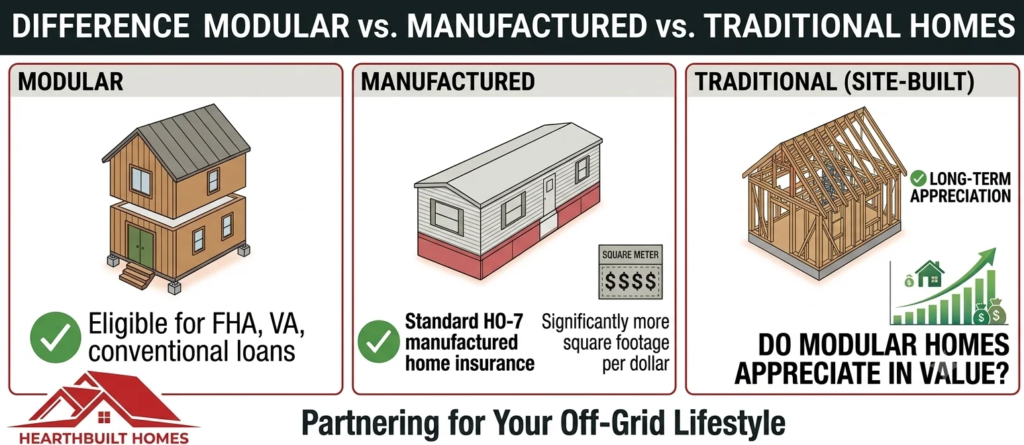
The Core Difference Modular vs. Manufactured vs. Traditional Homes
Before you can answer “do modular homes appreciate,” you have to separate modular construction from manufactured (mobile) home construction, because lenders, appraisers, and county assessors treat them completely differently.
- Modular homes are built in sections, or “modules,” inside a climate-controlled factory. Each module is then transported to the home site and assembled on a permanent foundation using a crane. Once assembled, the structure is functionally and legally identical to a site-built house.
- Manufactured (mobile) homes are built entirely to the federal HUD Code (established in 1976) rather than local building codes, and they typically remain on a permanent steel chassis even after installation. This chassis is the single biggest factor separating manufactured homes from modular and traditional homes in the eyes of lenders and tax assessors.
- Traditional stick-built homes are constructed entirely on-site, board by board, exposed to weather and site conditions throughout the build.
The regulatory distinction matters more than most buyers realize. Modular homes must comply with the same state and local building codes, typically the International Residential Code (IRC) that govern any traditional house built in that county. Manufactured homes, by contrast, are governed by a single nationwide HUD standard, regardless of local frost lines, wind loads, or seismic requirements. That single difference is why appraisers and lenders can treat a modular home exactly like a stick-built comp, while manufactured homes are frequently appraised, financed, and taxed on an entirely separate track.
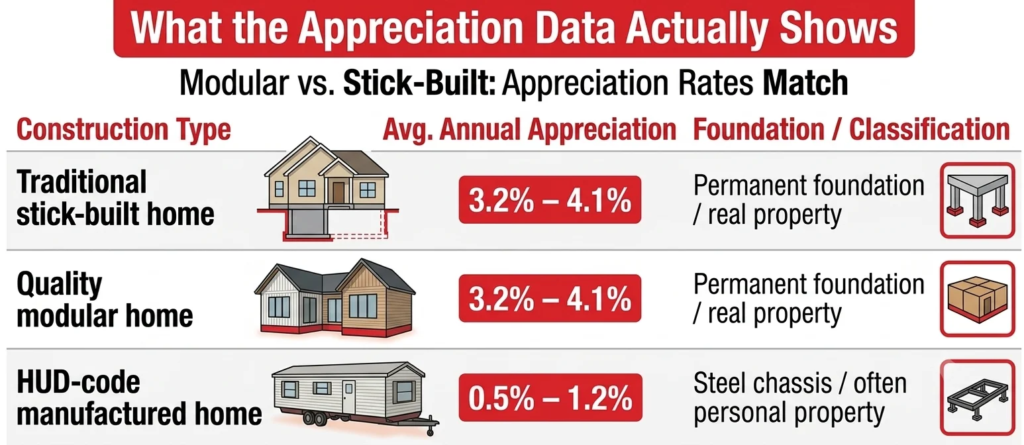
What the Appreciation Data Actually Shows
Federal Housing Finance Agency (FHFA) housing data consistently shows that homes affixed to a permanent foundation appreciate at comparable rates regardless of whether they were built on-site or assembled from factory-built modules. Once a structure is legally converted to real property foundation poured, chassis removed where applicable, title merged with the land, its value behaves like any other home in that market.
Construction Type | Avg. Annual Appreciation | Foundation / Classification |
Traditional stick-built home | 3.2% – 4.1% | Permanent foundation / real property |
Quality modular home | 3.2% – 4.1% | Permanent foundation / real property |
HUD-code manufactured home | 0.5% – 1.2% | Steel chassis / often personal property |
How Modular Homes Build Value and Appreciate Over Time
Here’s the mechanic that most buyers miss: a home rarely appreciates because of the structure sitting on top of the dirt. It appreciates because of the dirt. Land value driven by scarcity, local demand, school districts, job growth, and infrastructure is the primary engine behind real estate appreciation nationwide.
Because a modular home is legally classified as real property permanently attached to its lot, it rides that same land-value wave as any traditional neighbor on the block. This is the central reason the resale value of a modular home tends to track local market conditions rather than depreciate on a fixed schedule the way a vehicle or a manufactured home on a chassis might.
The Factory Quality Control Advantage
There’s also a structural argument for why modular construction can hold value exceptionally well, and it comes down to exposure. Modules are framed, wired, and finished indoors, which means the lumber, drywall, and insulation are never exposed to rain, snow, humidity swings, or job-site debris during the build. Building inspection data consistently shows that factory-built modules pass through multiple in-line quality assurance checkpoints before they ever leave the plant, catching defects that are far easier to miss on a wind- and weather-exposed traditional job site.
The practical result is a tighter building envelope with fewer warped studs, less trapped moisture, and more consistent squareness all factors that directly affect how well a home appraises and resells years down the line. This is one reason appraisers increasingly treat a well-built modular home as functionally equivalent, structurally, to its stick-built counterpart.
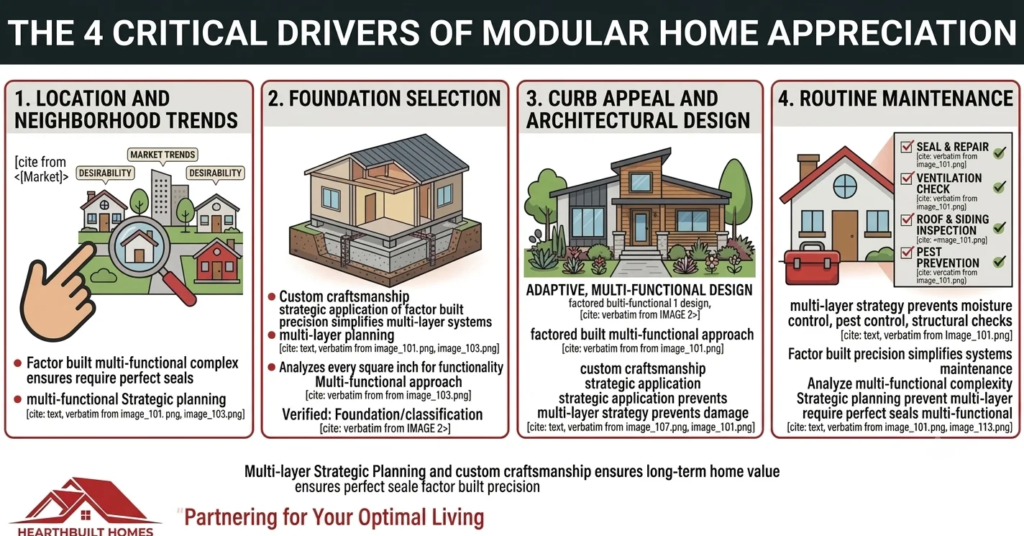
The 4 Critical Drivers of Modular Home Appreciation
If modular and traditional homes appreciate at similar rates on average, the natural next question is: what actually separates a modular home that appreciates strongly from one that stalls out? The answer has almost nothing to do with the fact that it was built in a factory.
- Location and neighborhood trends: A modular home built in a high-growth zip code will consistently outperform a site-built home sitting in a stagnant or declining market. Location remains the single strongest predictor of appreciation, full stop construction method is a distant second.
- Foundation selection: Choosing a permanent crawlspace or full basement foundation, rather than a temporary pier-and-block setup, locks in the home’s status as real property and unlocks conventional, FHA, and VA financing all of which widen your future buyer pool and support stronger resale pricing.
- Curb appeal and architectural design: Modern modular floor plans offer extensive exterior and interior customization, from siding materials to roof pitch to window packages, allowing a modular build to blend seamlessly into an upscale, architecturally consistent neighborhood.
- Routine maintenance: Upkeep rules are universal in real estate. A neglected roof, aging plumbing, or deferred structural repairs will erode value in a modular home exactly as they would in any traditional property.
Real estate case studies that compare identical modular floor plans placed in two different zip codes tend to show a wide appreciation gap between the two, a gap driven entirely by local market strength, not by the fact that the home arrived on a truck instead of a lumber pile.
The Immediate Equity Advantage of Modular Construction
Beyond long-term appreciation, modular construction offers something traditional building can’t: a financial head start on day one. Modular homes typically cost roughly 10% to 20% less per square foot to build than an equivalent stick-built home, driven by bulk material purchasing, standardized factory processes, and zero weather-related delays.
Because the foundation can be poured on-site at the same time the modules are being assembled in the factory, total construction timelines shrink by an estimated 30% to 60% compared to conventional building. That parallel workflow is the single biggest scheduling advantage modular construction has over traditional builds.
Why a Shorter Timeline Means More Equity
A shorter build timeline isn’t just a convenience, it’s a direct financial benefit. Every month a construction loan sits open, the homeowner pays interest on a rising balance before the home even generates any usable equity. Compress that timeline by half, and you meaningfully cut the total interest paid before move-in, which functionally means the homeowner starts their mortgage with more equity already banked relative to the purchase price.
Industry cost-benefit analyses, including research referenced in the Journal of Building Engineering, point to another underappreciated factor: material waste. Traditional job sites typically generate 10% to 15% material waste from over-ordering, weather damage, and on-site cutting errors. Factory settings, by contrast, operate closer to a near-zero waste model thanks to precision cutting and controlled inventory savings that get passed along in the build price and, ultimately, into the buyer’s initial equity position.