
With traditional single-family home prices and mortgage rates squeezing the average buyer out of the market, a growing number of people are looking toward alternative housing. But a lingering question remains: Is buying a mobile or manufactured home a smart financial move, or a depreciating trap?
To answer this honestly, we need to debunk the “mobile home” myth right away. Today’s manufactured homes are built to strict federal standards and offer luxury-level finishes at a fraction of the cost per square foot of site-built homes.
This comprehensive guide breaks down the true investment potential of modern manufactured homes. We’ll look at real appreciation data, the critical difference between owning the land versus renting a lot, hidden costs to watch out for, and how to maximize your resale value.
Manufactured vs Modular vs Mobile Homes: What’s the Difference?
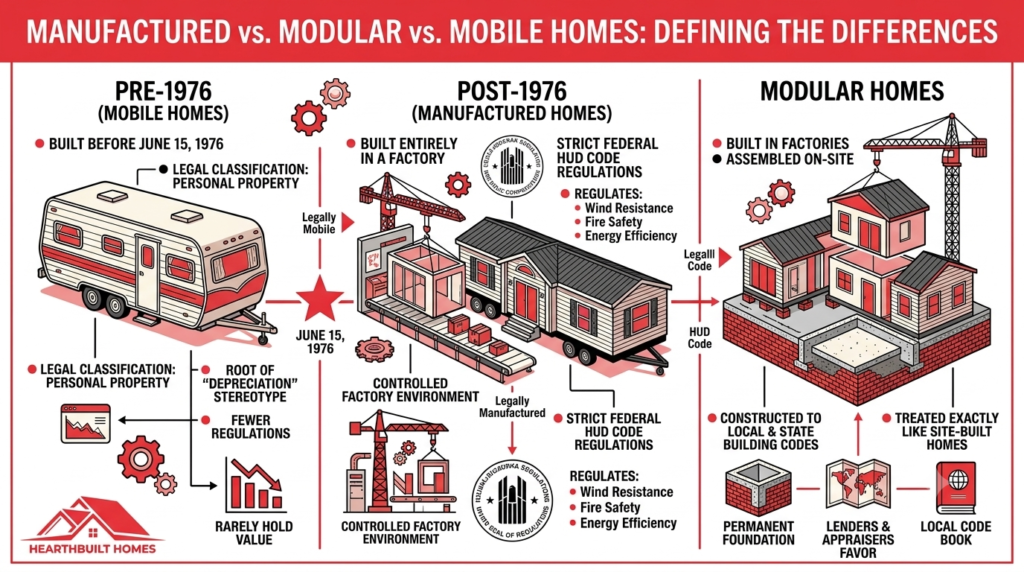
Before analyzing the financial returns, it is vital to understand exactly what you are buying. The terms are often used interchangeably, but the legal and structural differences heavily impact your investment’s value.
- Pre-1976 (Mobile Homes): Historically built with fewer regulations, these vintage units are the root of the “depreciation” stereotype. Legally, anything built before June 15, 1976, is a mobile home, and these rarely hold value.
- Post-1976 (Manufactured Homes): Built entirely in a controlled factory environment according to the strict federal HUD Code (Housing and Urban Development). This standard regulates structural strength, wind resistance, fire safety, and energy efficiency.
- Modular Homes: Also built in factories but assembled on-site, modular homes are constructed to local state and regional building codes rather than the HUD code. Consequently, lenders and appraisers treat them exactly like traditional, site-built homes from day one.
Key Takeaway: Modern manufactured homes are high-quality structures engineered to strict federal guidelines, distinguishing them entirely from the mobile homes of decades past.
Do Manufactured Homes Appreciate in Value?
The old adage that “manufactured homes lose value the moment you drive them off the lot like a car” is flat-out wrong in the modern real estate market.
Data from the Federal Housing Finance Agency (FHFA) House Price Index shows that manufactured housing appreciation rates can, and often do, track closely with traditional site-built homes. Furthermore, studies by organizations like the Urban Institute and LendingTree have revealed that in high-demand or high-cost-of-living areas, the median growth rate of manufactured home values frequently mirrors traditional real estate.
The ultimate determining factor in whether a manufactured home appreciates isn’t how it was built, it’s how it is titled and where it sits.
Land Ownership: The Ultimate Fork in the Road
If you want your manufactured home to be a wealth-generating asset, you face a critical fork in the road regarding land.
Scenario A: Real Estate (Land + Home)
Placing a manufactured home on a permanent foundation on land you own allows you to legally convert the property from personal property to “real property.”
- The home becomes legally tied to the land.
- The entire package appreciates as a standard real estate asset.
- This is where true long-term equity is built.
Scenario B: Personal Property (Chattel / Leased Land)
Placing a home in a mobile home park or on leased land means you pay monthly lot rent.
- The home is classified and taxed as personal property (like a vehicle or a boat).
- While the structure may still hold some value due to general housing scarcity, it is much more vulnerable to depreciation.
- You are exposed to the risk of rising lot rents, which eat into your overall return on investment.
How Much Does It Cost to Buy a Manufactured Home?
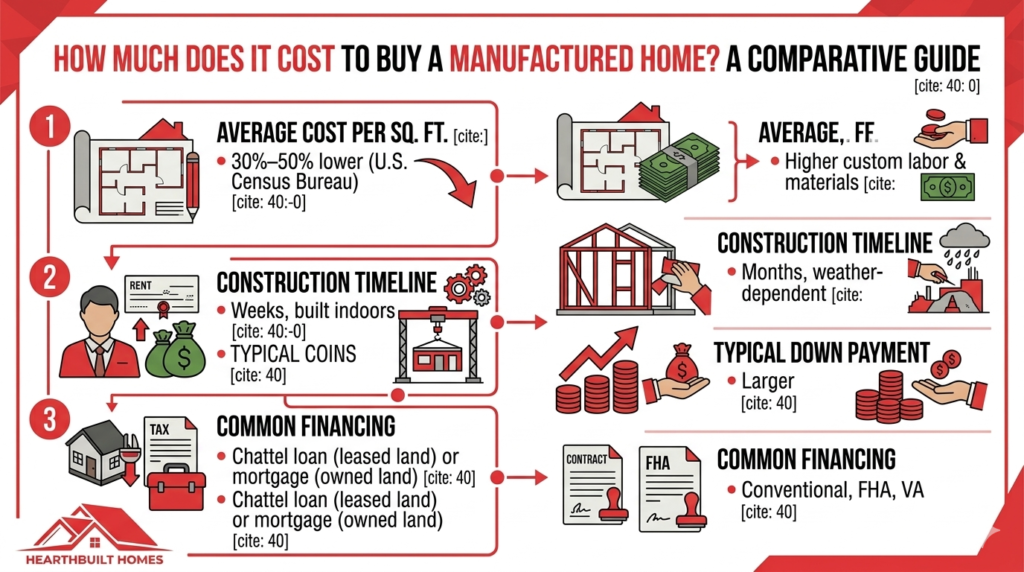
Cost is the entire reason manufactured housing exists as an investment category in the first place. According to the U.S. Census Bureau’s Manufactured Housing Survey, a manufactured home typically costs 30% to 50% less per square foot to build than a comparable site-built house, one of the clearest factory-homes-construction investment benefits on the market.
Cost Factor | Manufactured Home | Site-Built Home |
Average cost per sq. ft. | 30%–50% lower (U.S. Census Bureau) | Higher custom labor & materials |
Construction timeline | Weeks, built indoors | Months, weather-dependent |
Typical down payment | Smaller | Larger |
Common financing | Chattel loan (leased land) or mortgage (owned land) | Conventional, FHA, VA |
That lower entry price is also why buyers eventually ask, “what is my manufactured home worth?” If you own the land, a standard real estate appraisal using nearby comparable sales applies. If you don’t own the land, your home’s value gets pulled from manufactured-home-specific guides, the industry’s version of a vehicle blue book which weighs age, size, condition, and options rather than location.
The Financial Pros of Investing in a Manufactured Home
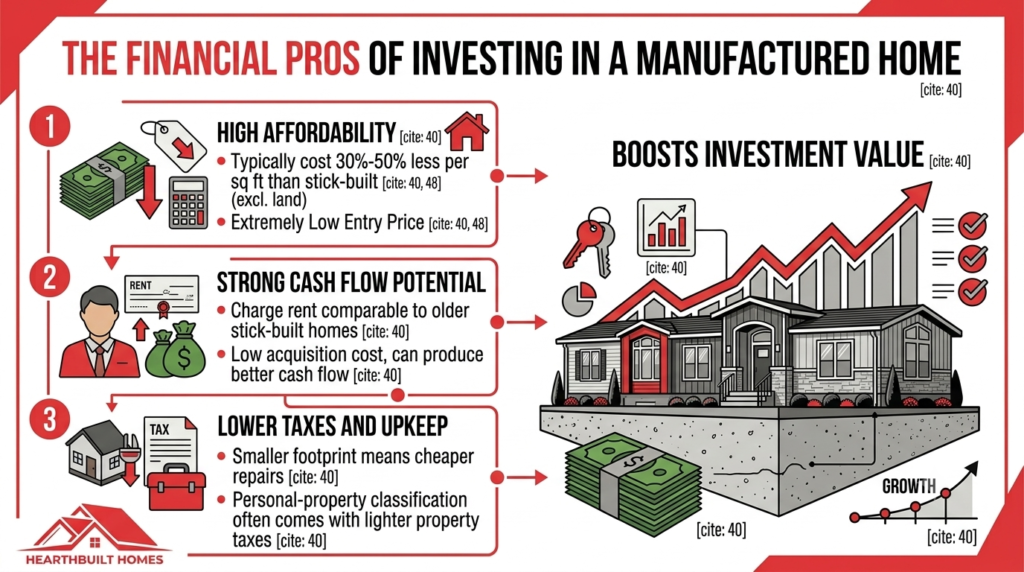
Benefit | Financial Impact |
Lower Cost per Square Foot | Typically 30% to 50% less expensive to construct than a traditional site-built home, according to the U.S. Census Bureau’s Manufactured Housing Survey. |
Lower Barrier to Entry | A lower purchase price means a smaller down payment, allowing buyers to escape the rent cycle and begin building equity years ahead of schedule. |
Predictable Construction Costs | Because they are built indoors, there are zero weather delays, material theft issues, or unexpected contractor overruns that plague traditional builds. |
The Cons and Risks to Watch Out For
While the entry price point is highly attractive, investors and homebuyers must navigate specific obstacles.
- Financing Hurdles: Traditional mortgages (FHA, VA, and Conventional loans) require the home to be on a permanent foundation on land you own. If you lease the land, you are often forced to take out a chattel loan. Chattel loans typically carry significantly higher interest rates and shorter repayment terms.
- Stigma and Zoning Laws: Outdated municipal zoning laws in many regions restrict where manufactured homes can be placed, sometimes forcing buyers into specific parks or rural areas.
- Stricter Resale Market: When it comes time to sell, your pool of qualified buyers might be smaller because the next owner will face the exact same financing hoops.
How to Maximize Your Manufactured Home’s Investment Potential
If you want to ensure your manufactured home acts as a wealth builder, follow this optimization checklist:
- Buy the Land: Never lease the dirt beneath your home if your primary goal is financial appreciation.
- Install a Permanent Foundation: Pouring a proper concrete foundation and removing the towing hitch/axles is the legal trigger required to convert the structure into appreciating real property.
- Upgrade Key Visuals: When ordering from the factory, opt for higher-pitched roofs, drywall instead of vinyl-covered wall panels, and site-built additions like covered porches or attached garages. This gives the home a traditional aesthetic that appraisers favor.
- Prioritize Energy Efficiency: Request an ENERGY STAR certified factory model. Lower utility bills maximize your monthly cash flow and serve as a strong selling point for future buyers.
Conclusion
Are manufactured homes a good investment? Yes, but with a major asterisk. If approached as a traditional real estate plan meaning you purchase the home, the land, and install a permanent foundational manufactured home functions as an incredibly accessible, high-yielding wealth-building tool.
However, if you purchase a home to place on leased land inside a park, you should treat it as an affordable housing solution rather than a financial investment. By understanding the critical role of land ownership and financing, you can leverage manufactured housing to build genuine equity without taking on traditional real estate debt.
If you are ready to turn the potential of alternative housing into a high-performance investment, HearthBuilt Homes is redefining what a modern factory-built home can be. Moving far beyond the outdated “mobile home” stereotypes, HearthBuilt Homes engineers customizable, factory-direct structures like the stunning G1 Tiny Cabin and the futuristic G2 Space Capsule built strictly to premium residential standards.
Whether you are a homebuyer looking to maximize your budget or a real estate investor searching for elite flip margins, HearthBuilt Homes eliminates middleman markups by sourcing materials direct from the factory. Featuring robust, climate-proof insulation capable of performing anywhere in North America and factory-direct SPC click-lock flooring, HearthBuilt Homes delivers the durability of a traditional site-built structure straight to your plot of land.
Don’t settle for leased lots and depreciating personal property. Build real real-estate equity today. Visit HearthBuilt Homes to explore customizable designs, browse bulk construction supplies, and request a custom quote delivered straight to your inbox within 24 hours.