
For decades, the word “prefab” conjured images of flimsy trailers and cookie-cutter boxes parked on cinder blocks. That stereotype is badly outdated. Today’s modular homes are engineered, code-compliant residences that can rival — and often outperform — traditional construction in quality, design, and long-term value.
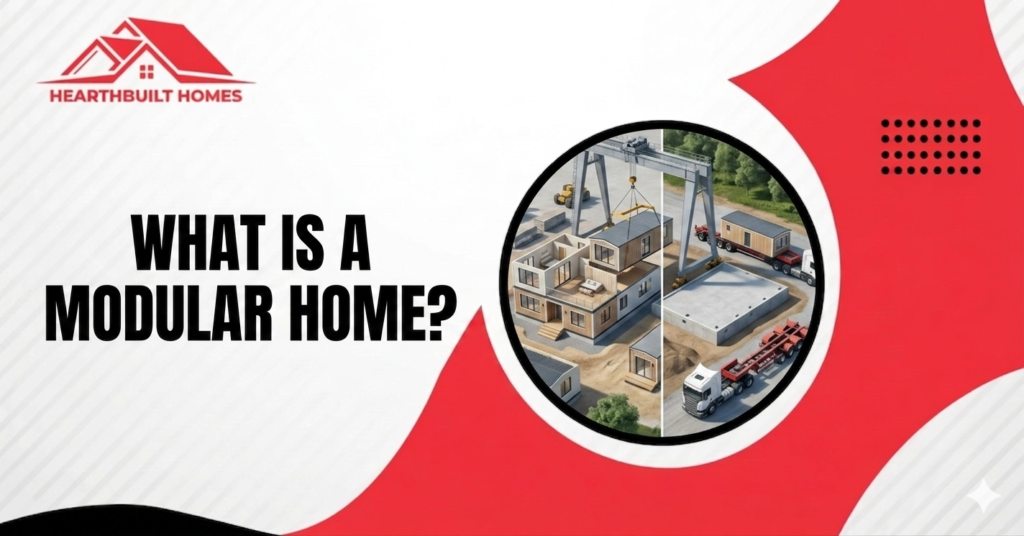
So what is a modular home, exactly? In simple terms, it’s a house built in sections inside a factory, then transported to your land and assembled on a permanent foundation. The result is a home that’s legally and structurally identical to one built entirely on-site, just constructed faster and with tighter quality control.
This guide walks through everything you need to know: how modular homes differ from manufactured and mobile homes, what the modular home construction process actually looks like, real cost ranges, financing options, and how much you can customize your final design. By the end, you’ll have a clear picture of whether going modular fits your next home-building project.
Understanding Modular Homes: Definition and Core Concepts
A modular home definition starts with where it’s built, not what it looks like. Instead of framing walls and running wiring outdoors at the mercy of rain, wind, and temperature swings, modular construction happens inside a climate-controlled factory. Skilled crews build each section — called a module — on an assembly line, then move it to the next station for insulation, drywall, plumbing, and finish work.
Once the modules are complete, they’re loaded onto flatbed trucks and driven to your home site. There, a crane lifts each section into place on a permanent foundation, and the modules are bolted and sealed together to form a single, continuous structure.
Here’s the golden rule of modular construction: once assembled, a modular home is structurally and legally indistinguishable from a traditional stick-built home. It isn’t a “temporary” or “lesser” form of housing. According to guidelines from the National Association of Home Builders (NAHB), modular homes must meet or exceed the same local and state building codes — often based on the International Residential Code (IRC) — that govern site-built construction in that jurisdiction.
That distinction matters enormously. Because modular homes are held to the same code standards as conventional houses, they appraise, finance, and appreciate the same way traditional real estate does. As a category of residential modular construction, prefab housing has matured significantly — a modular home definition that stops at “built off-site” misses the real story: it’s built off-site to the exact same standard as everything next door.
Modular vs. Manufactured vs. Mobile Homes: What’s the Difference?
If you’ve started researching prefabricated homes, you’ve probably seen “modular,” “manufactured,” and “mobile” used interchangeably. They are not the same thing, and the difference between modular and manufactured homes has real consequences for financing, zoning, and resale value.
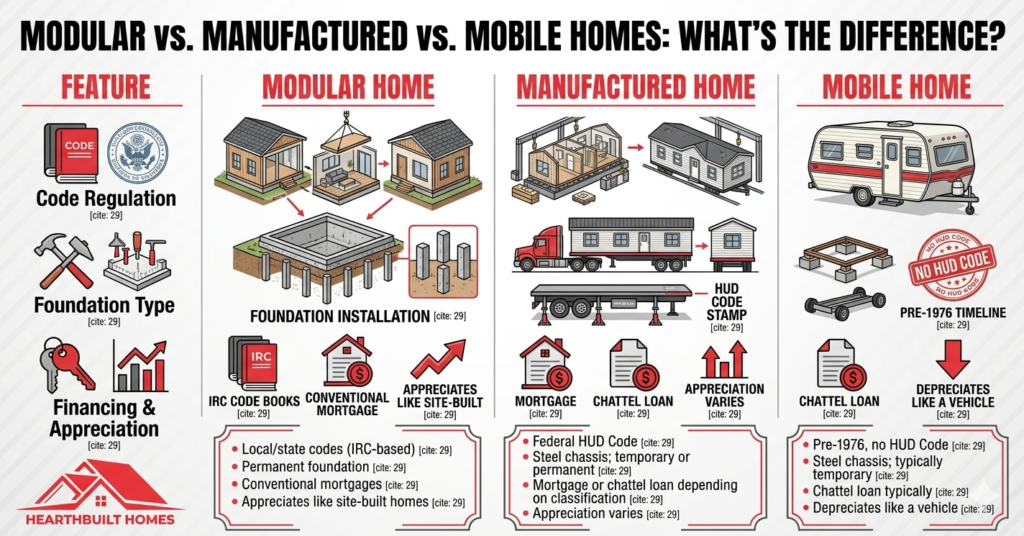
Modular homes are built to local and state building codes — the same codes that apply to a home built entirely on-site. They sit on permanent foundations and are treated like conventional real property. Because of this, modular vs. manufactured comparisons usually favor modular homes when it comes to qualifying for conventional mortgages and long-term appreciation.
Manufactured homes are built to a federal standard: the HUD Code, administered by the U.S. Department of Housing and Urban Development. They’re constructed on a permanent steel chassis, which allows them to be transported as a complete unit rather than in separate modules. Manufactured homes can be placed on either temporary or permanent foundations, and financing depends on whether the home is classified as real property or personal property (chattel).
Mobile home is technically a legacy term. Is a manufactured home a mobile home? Only if it was built before June 15, 1976 — the date the HUD Code took effect. After that date, federal law requires the term “manufactured home” instead.
Feature | Modular Home | Manufactured Home | Mobile Home |
Code Regulation | Local/state building codes (IRC-based) | Federal HUD Code | Pre-1976, no HUD Code |
Foundation Type | Permanent foundation | Steel chassis; temporary or permanent | Steel chassis; typically temporary |
Financing & Appreciation | Conventional mortgages; appreciates like site-built homes | Mortgage or chattel loan depending on classification; appreciation varies | Chattel loan typically; depreciates like a vehicle |
Understanding modular vs. manufactured distinctions upfront will save you headaches later, especially when you’re shopping for modular home financing or trying to confirm what your local zoning board will actually permit on your lot.
Inside the Modular Home Construction Process
The modular home construction process runs on a parallel timeline that traditional buildings simply can’t match. Here’s how factory-built homes go from blueprint to move-in ready, and how does a modular home work at each stage.
Phase 1: Design & Permitting
Your design team customizes floor plans and engineering specs, then submits them for approval. Local permitting offices review the plans against the same codes that govern any site-built home in the area, since the structure has to satisfy identical safety and zoning requirements.
Phase 2: Factory Fabrication & Concurrent Site Prep
This is where modular construction really pulls ahead. While your modules are being framed, wired, insulated, and finished inside the factory, crews back at your property are simultaneously grading the lot and pouring the foundation. Instead of one task waiting on the next, both happen at once — a major reason factory-built homes move so much faster than conventional builds.
Phase 3: Delivery & “The Set”
Once the modules are complete, they’re wrapped, loaded onto specialized trailers, and driven to your site. A crane then lifts each module into its exact position on the foundation, a process the industry calls “the set.” Watching a house arrive in pieces and get assembled in a single day is genuinely one of the more dramatic moments in residential construction.
Phase 4: Button-Up & Interior Finishing
With the modules set and bolted together, local contractors take over for modular home installation. They join the rooflines, connect plumbing and electrical systems between sections, and complete the interior trim and drywall seams where modules meet. This stage typically takes a few weeks rather than months.
The efficiency gains are well documented. Because fabrication happens indoors with precision tools and consistent material handling, factory construction reduces building waste by an estimated 30% to 40% compared to traditional site work. That same controlled environment also shortens total project timelines by roughly 30% to 50%, since weather delays, material theft, and on-site scheduling conflicts are largely eliminated.
Weighing the Benefits and Downsides of Modular Housing
No housing method is perfect for everyone. Here’s a balanced look at the pros and cons of modular homes so you can weigh modular home benefits against your own priorities.
Advantages of Prefab Homes
- Speed: Most modular homes are completed in a matter of weeks once the modules arrive on-site, versus months for a comparable site-built house.
- Quality control: Building indoors eliminates exposure to rain-soaked lumber, wind-driven moisture, and the warping that comes from materials sitting outside for weeks during a traditional build.
- Energy efficiency: Factory precision means tighter seams, more consistent insulation installation, and fewer of the small gaps that let conditioned air escape in conventional construction — a key reason energy efficient modular homes are gaining popularity.
- Reduced waste: Bulk material purchasing and computer-optimized cutting in the factory cut down on the scrap and overruns common on traditional job sites.
Downsides to Consider
- Land requirements: Unlike a builder who might package land into a deal, most modular companies require you to already own or separately purchase a suitable lot.
- Financing complexity: You’ll typically need a construction loan to cover the build, which then converts into a traditional mortgage once the home is complete and inspected.
- Site access restrictions: Delivering modules requires large trucks, and setting them requires crane access. Narrow roads, steep grades, or tight urban lots can complicate or add cost to delivery.
- Limited mid-build changes: Because so much of the home is finished before it ever reaches your lot, design changes need to happen early — there’s less room for adjustments once fabrication starts.
Weighing these pros and cons of modular homes against your specific site and timeline is the best way to know if this build method fits your situation.
How Much Does a Modular Home Cost? Price Breakdown & Financing
Modular home prices are usually quoted as a base price per square foot, but that figure only tells part of the story. As of recent industry data, base modular packages run roughly $100 to $200+ per square foot, compared to $150 to $300+ per square foot for fully site-built homes. Much of that savings comes from reduced labor hours and the near-total elimination of weather-related delays.
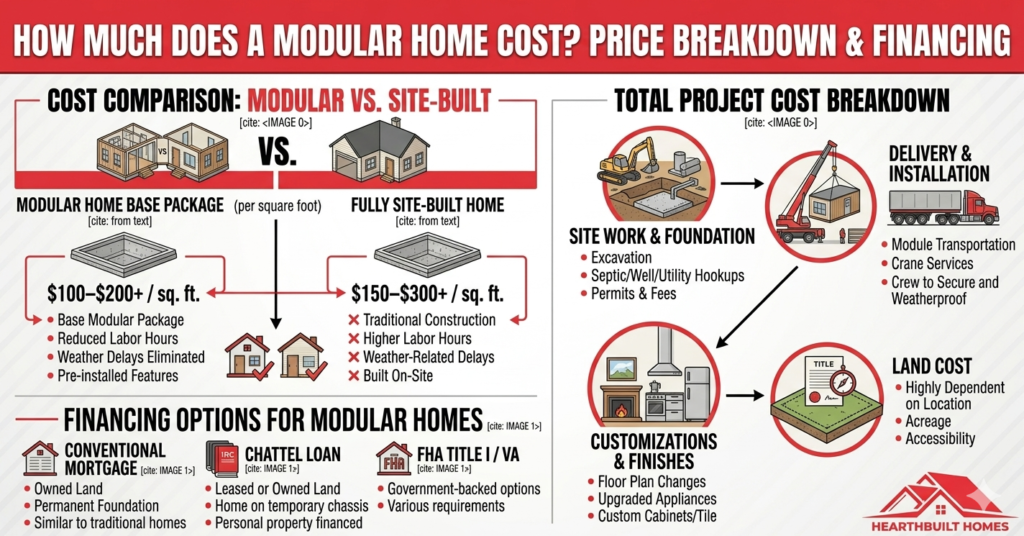
That base price covers the structure itself, not your finished, move-in-ready home. The full cost to build a modular home — often called the “all-in” cost — includes several line items the base price doesn’t:
- Land purchase (if you don’t already own a lot)
- Site clearing, grading, and excavation
- Pouring the permanent foundation
- Utility hookups (water, sewer/septic, electrical)
- Driveway and access road construction
- Permit and inspection fees
- Crane rental and delivery logistics
Because these costs vary so widely by region and lot conditions, it’s worth getting a detailed site evaluation before locking in a final budget.
On the financing side, modular home loans typically start as a construction-to-permanent loan. The lender releases funds in stages as the foundation is poured, modules are set, and finishing work is completed. Once the home passes final inspection and receives its certificate of occupancy, the construction loan converts into a standard mortgage — the same type you’d get for any traditional home purchase.
Dispelling the Myth: Customizing Your Prefab Masterpiece
One of the most persistent myths about prefab housing is that “factory-built” means “one design for everyone.” That hasn’t been true for years. Custom modular homes today span an enormous range of styles — sleek modern minimalist builds with clean lines and oversized windows, classic two-story colonials, cozy farmhouse designs, rustic log-cabin aesthetics, and Craftsman bungalows with all the architectural detail buyers expect.
Whether you’re browsing modular home floor plans for a compact starter home or a sprawling family residence, manufacturers offer dozens of base layouts as a starting point for further customization.
High-end finishes are fully on the table, too. Quartz and granite countertops, custom cabinetry, hardwood flooring, designer lighting packages, and whole-home smart technology are all routine modular home features with most manufacturers. The factory setting doesn’t limit your finishes — if anything, it allows for more precise installation of detailed work than is sometimes achievable on a rushed, weather-exposed job site.
If you can picture it in a traditional build, there’s a strong chance a modular manufacturer can build it for you.
Conclusion: Is a Modular Home Right for You?
A modular home gives you the speed, cost predictability, and quality control of factory construction, with the same long-term value and structural integrity as a traditional site-built house. The trade-offs — land logistics, financing steps, and site access — are manageable with the right planning.
Before you commit, work through a simple checklist: confirm your local zoning laws allow modular construction, interview at least two or three modular manufacturers, evaluate your land for site-access and utility readiness, schedule a modular home inspection at each build stage, and get firm “all-in” pricing rather than relying on base price alone.