

A move-in-ready starter home costs well over $400,000 in most major metro areas, yet a brand-new manufactured home can roll off the factory floor for under $150,000. That price gap raises an uncomfortable question for anyone running the numbers: if mobile homes are this affordable, why do so many investors still treat them as a financial dead end?
The honest answer is that mobile home investing rewards the prepared and punishes the careless in equal measure. There is no single verdict on whether “are mobile homes a good investment”, only a handful of variables that decide whether your purchase becomes a wealth-building asset or a depreciating liability.
This guide breaks those variables down with real market data, separates myth from fact on appreciation, and hands you a practical framework for deciding whether mobile homes, manufactured homes, or trailer homes belong in your portfolio.
Mobile Home vs. Manufactured Home: Why the Legal Definition Changes Your Risk
Anything built after that date is classified as a manufactured home and must meet the federal HUD Code for structural integrity, fire safety, and energy efficiency. That single date changes financing approval, insurance premiums, and long-term resale value.
People use the terms mobile home, trailer home, and manufactured home interchangeably, but lenders and appraisers do not. Homes built under the post-1976 HUD Code use drywall, full kitchens, and engineered insulation instead of the thin paneling and aluminum siding associated with older units.
That build-quality gap explains why the answer to are trailer homes a good investment usually depends on age. Pre-1976 units rarely qualify for competitive financing, and many insurers decline to cover them at all.
For investment purposes, stick to homes built after June 15, 1976, and confirm the HUD compliance certificate, a small metal plate usually mounted on the home’s exterior before making an offer.
The Golden Rule of Mobile Home Investing: Land vs. Leased Lot
In a leased-lot park, you own the structure but pay monthly lot rent to a park owner for the space underneath it. Park management can raise that rent, sell the property to a developer, or change tenant rules, leaving you to cover an expensive relocation for a structure that wasn’t built to be moved twice.
Buy the land along with the home, and the math flips. Once the unit sits on a permanent foundation and gets titled as real property, it starts behaving financially like a traditional stick-built house appreciating the surrounding mobile homes with land market rather than depreciating like a car.
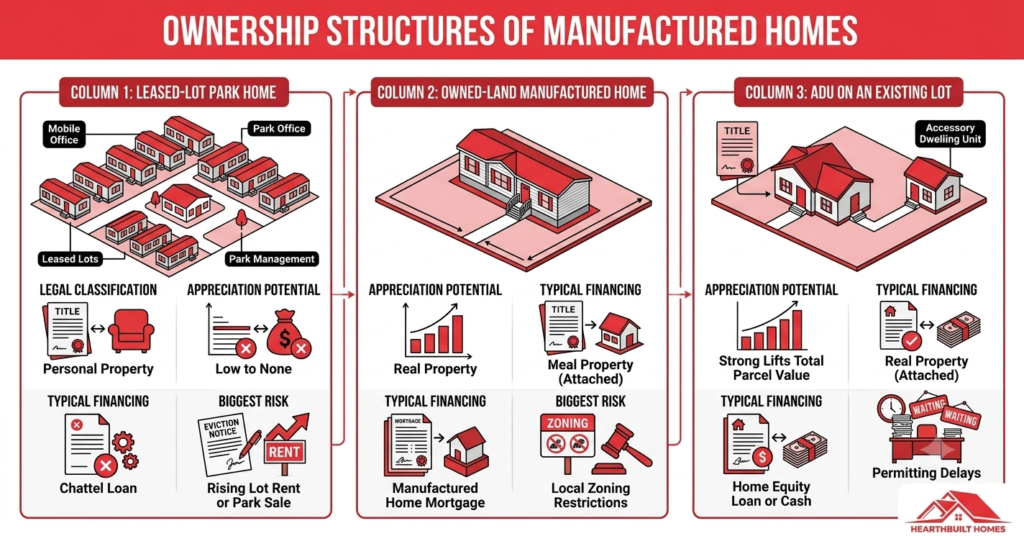
The table below breaks down how three common ownership structures compare:
Ownership Structure | Legal Classification | Appreciation Potential | Typical Financing | Biggest Risk |
Leased-lot park home | Personal property | Low to none | Chattel loan | Rising lot rent or park sale |
Owned-land manufactured home | Real property | Moderate to strong | Manufactured home mortgage | Local zoning restrictions |
ADU on an existing lot | Real property (attached) | Strong lifts total parcel value | Home equity loan or cash | Permitting delays |
Do Mobile Homes Appreciate or Depreciate? What the Data Shows
Manufactured homes sold together with the land beneath them tend to post mobile home appreciation rates close to traditional single-family homes in the same market, according to federal housing data. Units left on rented lots typically show mobile home depreciation year over year, because buyers are purchasing a structure rather than real estate.
The value isn’t dictated by whether a home was built in a factory or on-site. It’s dictated by the same three drivers that move every other property: location, maintenance, and legal classification.
- Location a unit in a high-growth suburb climbs in value faster than one in a declining rural market.
- Maintenance a sound roof, intact skirting, and updated systems protect mobile home resale value far more than the brand on the data plate.
- Zoning and classification titling the unit as real estate, rather than personal property, opens it up to a much larger pool of buyers and lenders.
Pros and Cons of Buying a Mobile Home
The Financial Pros
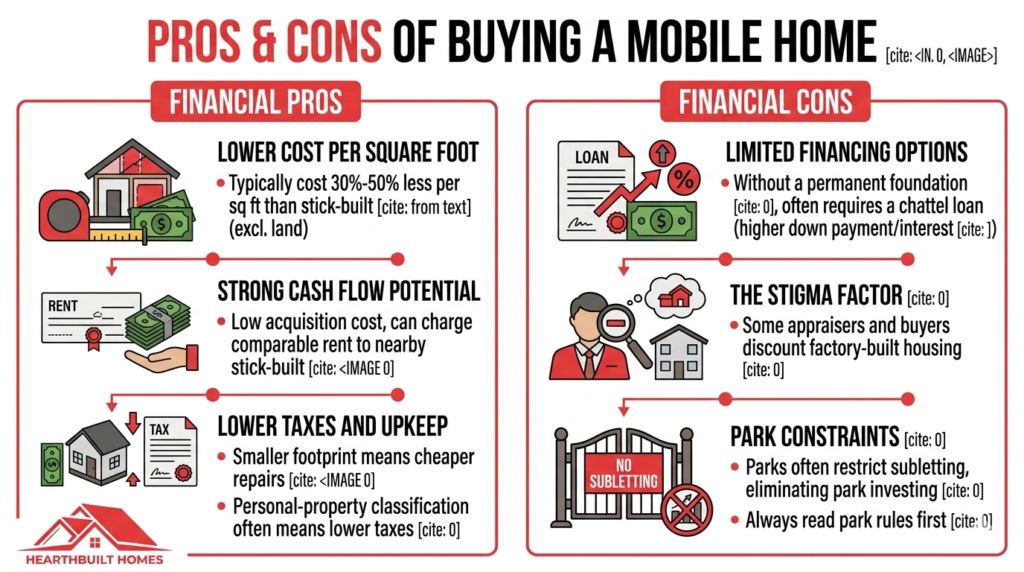
- Lower cost per square foot manufactured homes typically cost 30% to 50% less to produce per square foot than stick-built homes, excluding land, which is one of the clearest mobile home ownership benefits for first-time buyers.
- Strong cash flow potential because acquisition cost is low, landlords can charge rent comparable to older stick-built homes nearby, producing some of the better cash flow from mobile homes in residential real estate.
- Lower taxes and upkeep a smaller footprint means cheaper repairs, and personal-property classification often comes with a lighter property tax bill.
The Financial Cons
- Limited financing options homes without a permanent foundation usually require a chattel loan, which carries higher down payments and noticeably higher interest rates than a conventional mortgage.
- The stigma factor despite major quality improvements, some appraisers and buyers still discount factory-built housing out of habit rather than data.
- Park constraints Many parks restrict subletting entirely, which can eliminate a mobile home park investing strategy before it starts; always read the park rules first.
Mobile Home Investing Strategies for Beginners
Once the legal and financial basics are clear, investing in mobile homes comes down to picking a strategy that matches your capital, time, and risk tolerance.
- The Live-In Flip: Buy a manufactured home on undervalued land, live in it while making cosmetic upgrades like paint, flooring, and fixtures, then sell the whole package as real property.
- The Affordable Rental Cash Cow: Focus on buying used mobile homes inside a well-managed, low-lot-rent park, renovate the interior, and rent it out to tap into steady demand for affordable housing.
- The ADU Play: If you already own a traditional home with a large lot, place a smaller manufactured unit on the property as a legal accessory dwelling unit, doubling the rental income on a single parcel.
- Mobile Home Park Investing: Buy the park itself rather than individual units, collecting lot rent from every tenant.
This scales fast, but financial coaches frequently warn that heavy debt service can erase the entire return when rents sit below market and verify the cash-on-cash numbers before closing.
How to Buy a Mobile Home and Land: Your Investment Checklist
Before signing anything, run the property through this checklist:
- HUD Compliance: Confirm the home was built after June 15, 1976, and locate the compliance plate. Avoid pre-1976 units for investment purposes.
- Land Ownership: Either own the land outright or thoroughly review the park’s lot-rent history and lease terms.
- Foundation Status: Verify the home is attached to a HUD-approved permanent foundation, which is required for real-property classification.
- Financing Terms: Get loan quotes before you shop. If a chattel loan is your only option, confirm the expected rent or appreciation clears the higher interest rate.
- Zoning and HOA Rules: Confirm local zoning and any HOA explicitly permit manufactured structures and, separately, rental use.
Conclusion
So, are mobile homes a good investment? The deal works when it’s structured around land. A standalone unit on a rented lot in a park behaves like a vehicle: it provides genuinely affordable shelter, but it’s unlikely to build generational wealth.
Pair a modern manufactured home with owned land, or deploy it as a high-yield rental, and it turns into one of the more efficient, low-cost ways to enter real estate.
Run your own numbers before you commit, plug your expected purchase price, down payment, and rate into a mortgage calculator and compare the result against local rental rates. Already own a mobile home, or thinking about buying one? Drop a comment with your numbers below, and we’ll help you sanity-check the deal.