
Buying a home used to mean driving from lot to lot, settling for whatever floor plan a dealer happened to have in stock, and hoping the kitchen layout wasn’t an afterthought. That process is fading fast.
Today, you can design your own mobile home online, swapping cabinet finishes and shifting interior walls from your couch, long before a single panel leaves the factory floor.
The challenge has always been finding a home that fits both your budget and your taste at the same time. Custom mobile homes solve that tension by handing the buyer creative control over floor plans, finishes, and fixtures using interactive 3D configurators that manufacturers now build directly into their websites.
This guide breaks down how those online design tools actually work, what you can realistically customize, how to keep your dream layout compliant with local zoning, and what it takes to move your finished design from a digital model to a delivered home.
The Rise of the Digital Builder: What Are Custom Mobile Homes?
Custom mobile homes are manufactured or modular houses built in a factory to a buyer’s specific design choices, rather than pulled fully finished off a dealer’s lot. The category has moved a long way past the boxy, single-layout trailers of decades past — modern custom built mobile homes now routinely include vaulted ceilings, kitchen islands, walk-in closets, and farmhouse-style exteriors that are difficult to distinguish from site-built houses at a glance.
What actually changed is the design process itself. Static paper blueprints and a handful of pre-set floor plans have given way to the virtual home builder — an interactive 3D configurator that lets shoppers rotate a digital model of their future home, swap siding colors, and watch room layouts shift in real time. Instead of imagining how a 200-square-foot reduction in the living room might feel, buyers can actually see it before committing.
That “seeing before buying” effect matters more than it sounds. Committing to a 1,500-square-foot home is a major financial decision, and abstract floor plans leave a lot of room for buyer’s remorse. A 3D walkthrough closes that gap by letting you preview the finished product, catch awkward layouts early, and adjust the design before production starts — not after move-in.
Industry data compiled from Manufactured Housing Institute (MHI) reporting shows new manufactured homes averaging roughly $85 to $87 per square foot to build, compared with about $166 to $168 per square foot for traditional site-built construction — nearly half the cost for a comparable footprint.
More than 22 million Americans currently live in manufactured housing, and factory-built homes now account for roughly one in every ten new homes constructed nationwide each year, according to MHI-sourced research. That affordability gap, paired with the newfound ability to fully personalize a layout, is a big part of why customized mobile homes have shifted from a budget fallback into a deliberate lifestyle choice for a growing share of buyers.
Step-by-Step: How to Design Every Detail Online
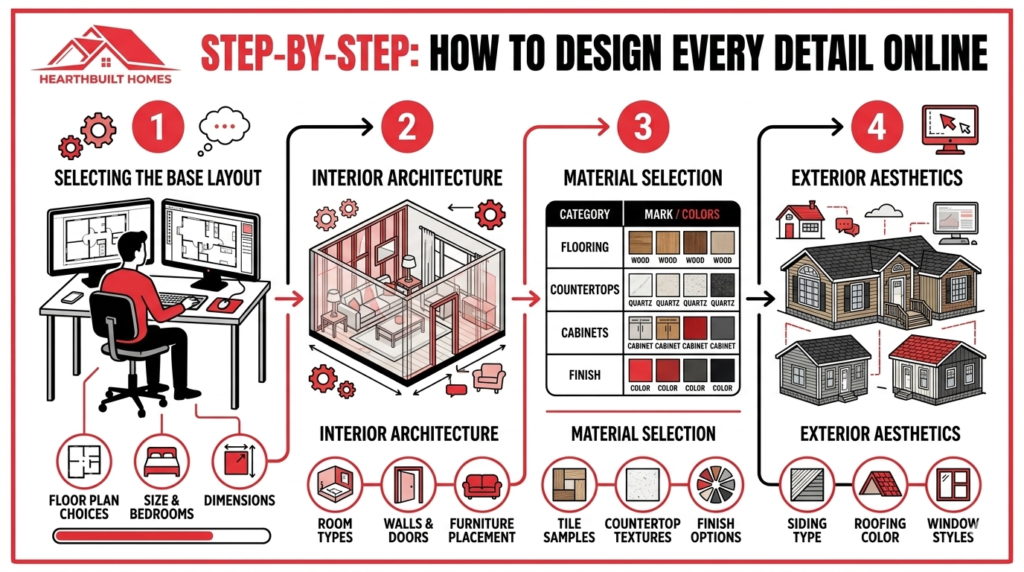
Designing custom mobile home floor plans online generally follows four phases. Most online 3D home designer tools walk you through these in order, locking in the big structural decisions before moving on to finishes.
Phase 1: Selecting the Base Layout
Your first decision is footprint — single-wide, double-wide, or triple-wide — and it drives almost everything downstream: square footage, transport logistics, and ultimately price.
Layout | Typical Width | Typical Square Footage | Best For |
Single-wide | 14–18 ft | 600–1,300 sq ft | Tight lots, starter homes, rental or guest units |
Double-wide | 20–36 ft (2 sections) | 1,000–2,300 sq ft | Families wanting open-concept living |
Triple-wide | 30–60+ ft (3 sections) | 2,000–3,500+ sq ft | Buyers who want site-built-scale custom triple wide mobile homes |
If you’ve searched for custom triple wide mobile homes for sale, you’ve likely noticed they increasingly compete with site-built houses on raw square footage, often including a separate primary suite, a home office, and a formal dining area within one footprint.
Phase 2: Interior Architecture
Once the footprint is locked in, configurators let you manipulate interior walls and room functions. Common choices include:
- Open-concept living vs. a split-bedroom layout that separates the primary suite from secondary bedrooms
- Adding a dedicated home office or flex room
- Choosing a galley, L-shaped, or island kitchen configuration
- Adjusting bathroom count and laundry room placement
Phase 3: Material Selection
This is where the idea of how to customize a mobile home stops being abstract and starts feeling like real interior design work. Typical configurator choices include:
- Flooring: luxury vinyl plank (LVP), carpet, or laminate
- Countertops: quartz, granite, or laminate
- Cabinetry: shaker-style, flat-panel, or raised-panel doors across a range of finishes
- Interior trim, hardware finishes, and paint palettes
Phase 4: Exterior Aesthetics
The exterior configurator typically covers:
- Roof pitch and roofline style
- Siding material — vinyl, cedar shake, or fiber cement
- Window placement and trim color
- Add-ons like covered porches, decks, and skirting
Beyond Aesthetics: Smart Customizations You Shouldn’t Skip
It’s easy to spend an afternoon picking countertop colors and forget the upgrades that actually affect your monthly bills and long-term comfort. A few categories deserve attention before you finalize your design.
Energy Efficiency
Federal rules increasingly shape what “standard” efficiency looks like in a new manufactured home. The U.S. Department of Energy’s building thermal envelope standards apply on a tiered basis — lighter requirements (Tier 1) for single-section homes and stricter requirements (Tier 2) for multi-section homes — and both are based on insulation and air-sealing provisions drawn from the 2021 International Energy Conservation Code. DOE has estimated that these updated standards could save residents an average of roughly $475 per year on utility bills compared with older-built homes, though compliance timelines have shifted in recent rulemaking, so it’s worth confirming current effective dates with your builder.
Beyond what’s required by code, most configurators let you opt into additional upgrades:
- ENERGY STAR®-certified appliances
- Radiant barrier roof decking to reduce attic heat gain
- High-efficiency HVAC systems sized specifically for your square footage
Structural Integrity
One of the highest-value upgrades is wall construction. Standard 2×4 framing is code-compliant, but stepping up to 2×6 exterior walls increases the cavity depth available for insulation, which raises your wall’s R-value (a measure of resistance to heat flow, where higher numbers mean better insulation) and generally improves wind resistance in storm-prone regions.
Tech Integration
Pre-wiring decisions are far cheaper to make on a digital floor plan than to retrofit after the home is built. Popular add-ons include:
- Structured wiring for smart home hubs, security cameras, and networked thermostats
- Roof bracing and conduit prep for a future solar panel installation
- A dedicated circuit and outlet for electric vehicle (EV) charging near the carport or driveway
Navigating the Logistics: From Digital Screen to Physical Site
A polished 3D design means nothing if it can’t legally be placed where you want to live. This is the step where many first-time buyers get tripped up.
The HUD Code
Every manufactured home built in the U.S. since June 15, 1976 must comply with the Manufactured Home Construction and Safety Standards, commonly known as the HUD Code. It governs structural design, fire resistance, electrical and plumbing systems, transportability, and — increasingly — energy performance. A red certification label affixed to each transportable section confirms compliance, and that label matters later for financing, insurance, and resale.
Zoning and Land Prep
Your online design also has to match the wind, snow, and thermal zone requirements assigned to the home’s actual destination, not the showroom’s location. Local zoning ordinances can further restrict mobile home placement to certain districts, set minimum square footage, or require specific foundation types — so it’s worth confirming zoning rules before you finalize a custom layout, not after the home is already in production.
Permitting and Foundations
Foundation choice affects both your permitting path and how the home gets classified for financing purposes:
- Pier and beam (temporary foundation): Lowest upfront cost, common on leased land, and generally keeps the home classified as personal property
- Permanent foundation (crawlspace or basement): Typically required for conventional and FHA Title II mortgages, since lenders need the home classified as real property
Budgeting for Your Custom Mobile Home
Online configurators are genuinely good at one thing: real-time pricing. Add a quartz countertop upgrade or a covered porch, and the on-screen total updates instantly. But that number is only one piece of your total custom mobile home cost.
What the Online Price Doesn’t Include
- Land acquisition and site clearing
- Utility hookups for water, sewer or septic, and electric
- Delivery and set-up fees, often running roughly $3–$10 per mile for transport alone
- Foundation work, ranging from around $1,000 for a basic pier system up to $40,000 or more for a full basement
Financing Your Custom Build
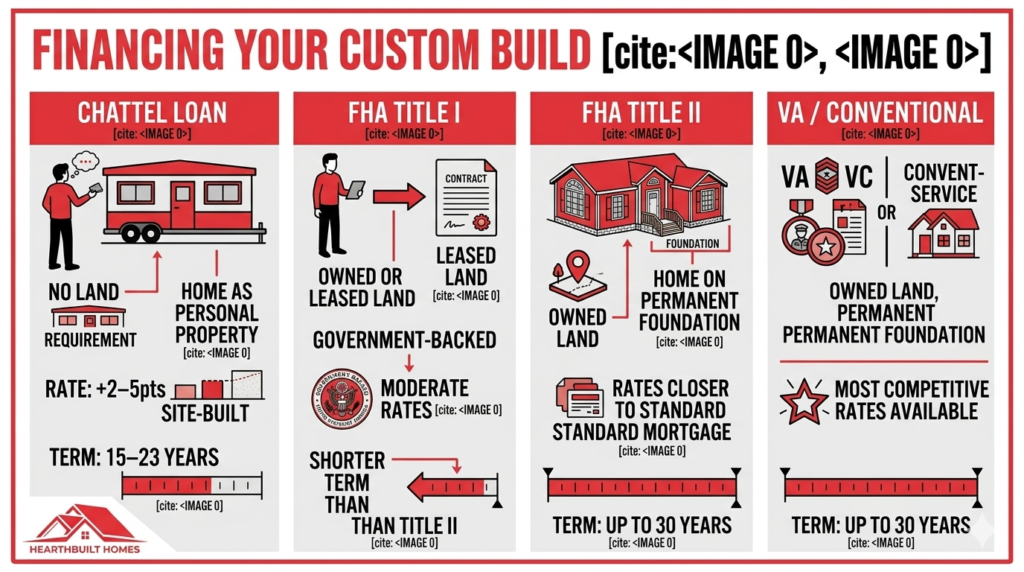
Once you own land, or once you decide to keep the home on leased land, your financing path narrows considerably. Here’s how the main options compare:
Financing Type | Land Requirement | Typical Rate Impact | Typical Term |
Chattel loan | None — home financed as personal property | 2–5 percentage points above site-built mortgage rates | 15–23 years |
FHA Title I | Owned or leased land (3+ year lease) | Government-backed, moderate rates | Shorter than Title II |
FHA Title II | Owned land, home on permanent foundation | Closer to standard mortgage rates | Up to 30 years |
VA / Conventional | Owned land, permanent foundation | Most competitive rates available | Up to 30 years |
Per Consumer Financial Protection Bureau data, roughly 42% of all manufactured home purchase loans are chattel loans — largely because so many buyers don’t own the land their home sits on. If long-term equity matters to you, it’s worth discussing the path from chattel financing to a permanent-foundation mortgage with your lender before you finalize your design.
Finding Reputable Custom Mobile Home Builders Near You
When you search for custom mobile home builders or custom mobile homes near me, a few signals separate the builders worth your time from the ones that will leave you with surprise costs later:
- Builders who let you walk through itemized, real-time pricing rather than a single bundled quote
- Transparency about HUD Code compliance, with certification documentation provided up front
- An established local dealer network, or the option to tour an in-progress build at the factory
- Recent customer reviews specifically mentioning delivery timelines and post-install service
Comparing two or three builders on these points before you start customizing will save you from falling in love with a floor plan that the closest dealer can’t actually deliver to your area.
Ready to Start Designing?
Designing a custom mobile home online bridges the gap between premium personalization and affordable real estate. By working through the base layout, interior architecture, materials, and smart upgrades in a 3D configurator — and lining up zoning, permitting, and financing before you commit — you take control of your housing budget without sacrificing the design you actually want.