
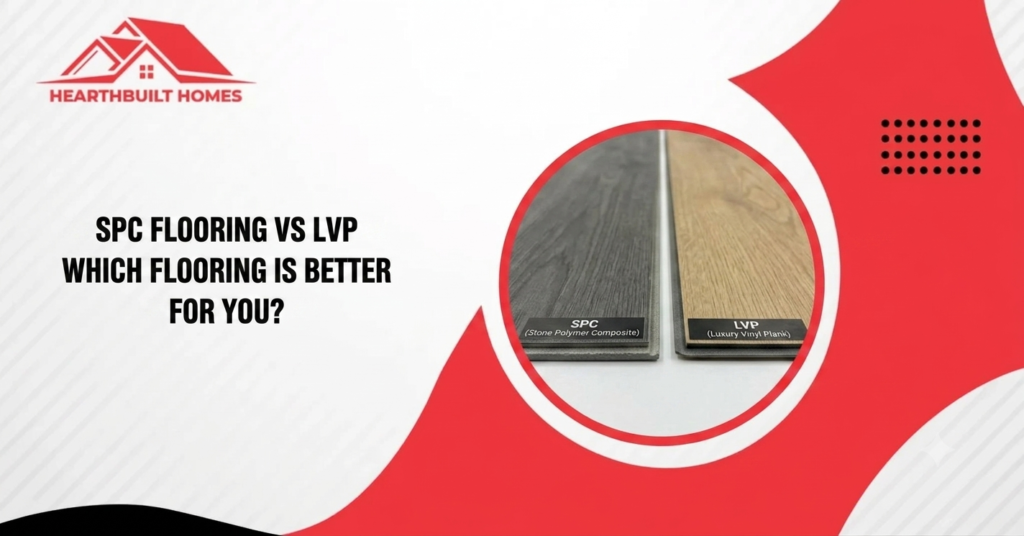
A cast-iron skillet slips from your hands and crashes onto your brand-new kitchen floor. With a standard flexible luxury vinyl plank (LVP), you may be staring at a permanent gouge that haunts every dinner party for the next decade. With Stone Plastic Composite (SPC) flooring, you pick up the pan, wipe the surface, and move on. Both floors belong to the same vinyl family and look nearly identical from the surface. But what lives inside the plank changes everything about how each one performs under the daily pressures of real life.
The terms SPC flooring vs. LVP are used interchangeably in showrooms and online listings constantly and that confusion costs homeowners money. Choosing the wrong core for your specific room can mean buckled planks in a sun-soaked sunroom, visible subfloor bumps ghosting through a soft vinyl floor, or simply overpaying for commercial-grade rigidity in a quiet upstairs bedroom.
This guide cuts through the industry noise. We’ll compare these two flooring categories across six critical battlegrounds: core construction, durability, climate stability, underfoot comfort, DIY installation, and overall cost. By the end, you’ll know precisely which plank belongs in each room of your home — no guesswork required.
Decoding the Core — What Is SPC Flooring and What Does LVP Stand For?
The single most important thing to understand about composite vinyl flooring is that the battle is fought at the core. Both SPC and traditional LVP share identical surface layers — a photographic wood-grain print film and a protective wear layer measured in mils — but everything underneath those layers tells a completely different story.
What Does LVP Stand For in Flooring?
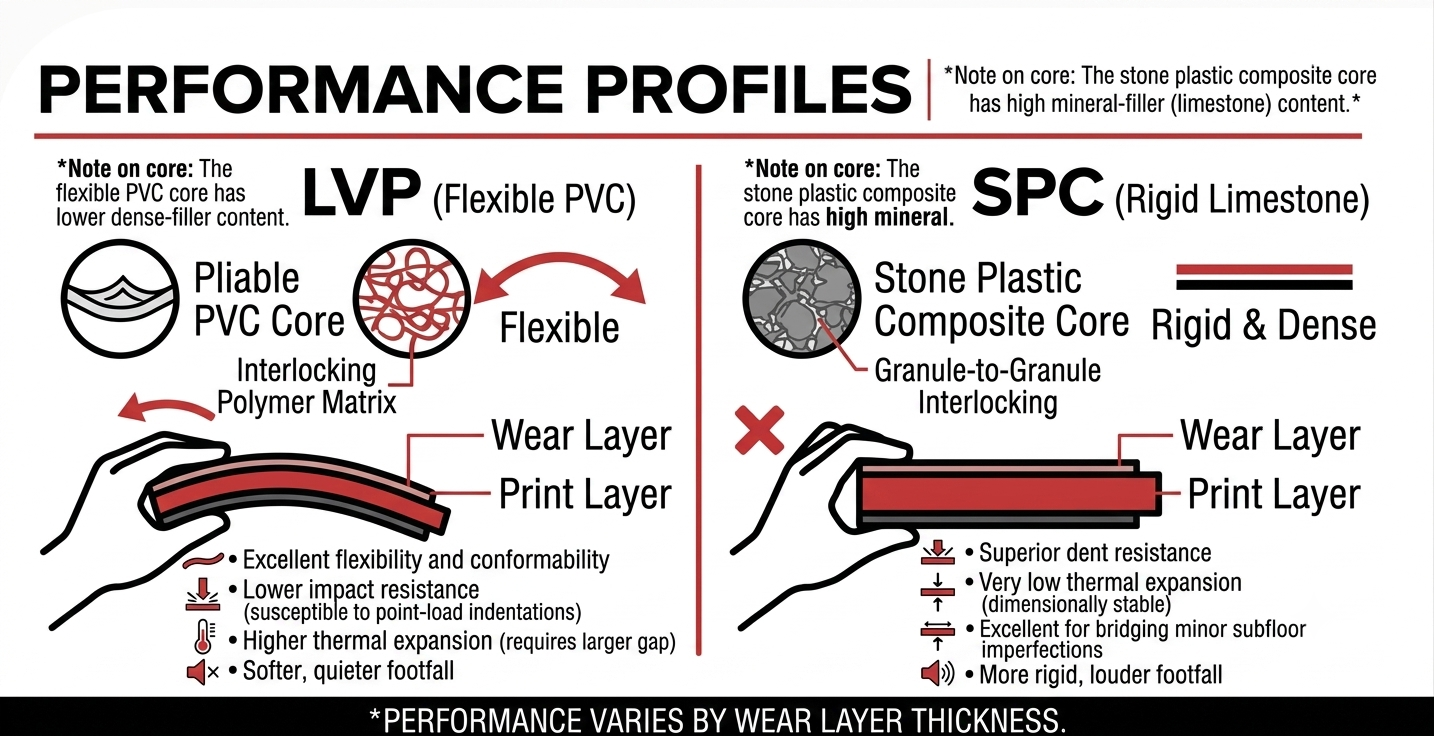
LVP stands for Luxury Vinyl Plank, a broad category of resilient flooring built on a 100% synthetic polyvinyl chloride (PVC) core. That core is inherently flexible — you can bend a traditional LVP plank with your hands. This pliability made LVP revolutionary when it hit the market because it was waterproof, affordable, and far more realistic-looking than earlier vinyl sheet products. The flexibility also made it somewhat forgiving underfoot.
What Is SPC Flooring?
SPC stands for Stone Plastic Composite — and SPC flooring meaning is right there in the name. Its core is an engineered blend of approximately 60% natural limestone powder, PVC, and chemical stabilizers, compressed and bonded into an extremely dense, fully rigid board. Unlike flexible LVP, an SPC plank will not bend. Try to flex one, and it will snap before it curves.
This is SPC flooring technology at its core: the limestone mineral filler displaces a significant portion of the synthetic plastic, creating dimensional stability that a 100% PVC board simply cannot achieve. The stone particles interlock at a microscopic level, preventing the thermal expansion and compression deformation that afflicts traditional LVP under stress.
The Layer-by-Layer Breakdown
Both floor types share the same top two layers:
- Wear Layer: A clear urethane coating (ranging from 6 mil for entry-level to 30 mil for commercial-grade) that protects the floor from scratches, scuffs, and surface moisture.
- Print/Photo Layer: A high-definition photographic film that replicates the look of real wood, stone, or tile.
Where they split apart:
- SPC Core: Dense, rigid limestone composite. Unyielding and dimensionally stable.
- LVP Core: Flexible PVC. Pliable, softer, and more susceptible to heat and heavy loads.
- Backing/Underlayment Layer: Both may include a thin foam or IXPE acoustic pad bonded to the bottom.
Durability Face-Off — SPC Flooring Durability, Dent Resistance & Everyday Wear
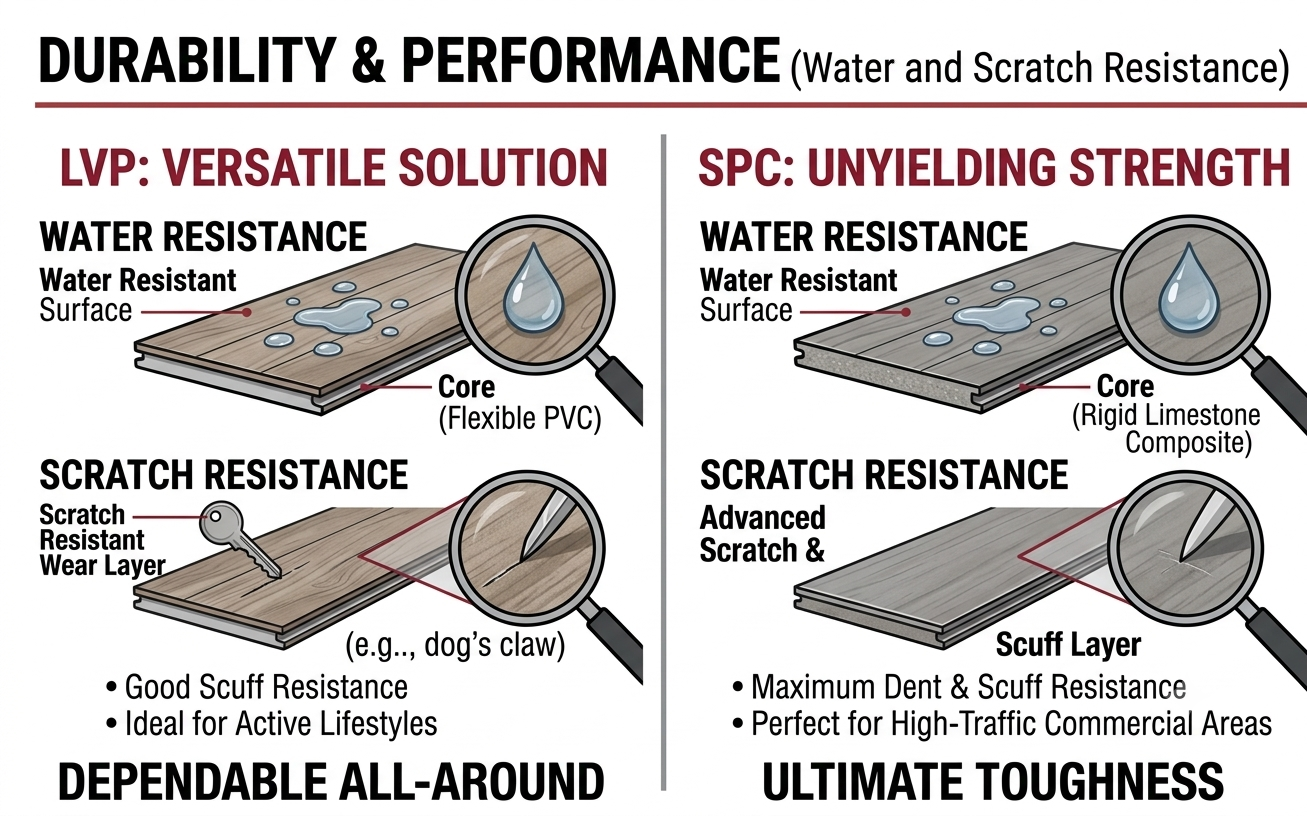
When it comes to head-to-head durability, SPC flooring wins decisively for impact resistance and dent protection — but scratch resistance is a different story, and that distinction matters.
Impact & Dent Resistance: SPC’s Core Advantage
Dent resistance is purely a function of core density. Traditional LVP, with its flexible PVC core, compresses under concentrated, sustained pressure. This means the legs of a grand piano, a refrigerator, or a pool table will gradually press dimples into the surface. Those dimples are permanent.
SPC’s limestone composite core is rigid enough to distribute weight laterally across the plank rather than compressing vertically. The floor essentially acts as a structural bridge. Heavy furniture, appliances, and high-heel traffic that would permanently mark a flexible LVP plank simply sit on top of an SPC floor without leaving a trace.
The Scratch Resistance Myth: It’s All About the Wear Layer
Here is one of the most common misconceptions in the flooring industry: many shoppers assume SPC is more scratch-resistant than LVP because it’s harder. This is incorrect. Scratch resistance is determined entirely by the thickness of the wear layer, not the core.
A 20-mil LVP and a 20-mil SPC plank will perform identically when it comes to dog claws, dragged chair legs, and dropped keys. A 6-mil SPC will be far more vulnerable to scratches than a 20-mil LVP. When shopping for the best vinyl flooring for dogs or active households, always prioritize wear layer thickness (12 mil minimum for pets; 20 mil for serious traffic).
Lifespan Expectations
- SPC Flooring: 15–25+ years in high-traffic residential and light commercial settings. The rigid core resists structural fatigue under sustained load.
- Traditional LVP: 10–20 years under normal residential use. Performance degrades faster in environments with heat stress, moisture at seams, or heavy static loads.
Climate and Stability — Temperature Shifts, Moisture & Buckling Vinyl Planks
On temperature and moisture stability, SPC flooring is the clear winner, and the physics of its limestone core explain exactly why.
The Moisture Truth: Both Are Waterproof, But Not Equally
Both SPC and traditional LVP are inherently 100% waterproof vinyl flooring — water cannot penetrate the plank itself. However, the critical difference lies at the seams and what happens during a structural flooding event.
Traditional LVP’s flexible click-lock connections can warp, lift, or gap when water sits beneath or between planks for extended periods. The flexible core absorbs stress and deforms. SPC’s rigid click-locks are far less susceptible to this kind of seam disruption. For basements, bathrooms, laundry rooms, and kitchens, SPC’s rigidity provides meaningful additional protection against flood-level moisture events.
Thermal Expansion and Buckling: LVP’s Achilles Heel
SPC temperature stability is one of its defining advantages. All flooring materials expand when heated and contract when cooled — the concern is the degree of that movement.
Traditional flexible PVC has a high coefficient of thermal expansion. In a sunroom with floor-to-ceiling windows, south-facing rooms with intense afternoon sun, or any space that heats beyond roughly 95°F, LVP can expand enough to cause plank edges to lift and buckle — a phenomenon that ruins the look of an otherwise beautiful floor.
SPC’s limestone mineral content dramatically reduces this expansion rate. The stone filler physically constrains the PVC’s thermal movement. SPC is widely rated for spaces with greater temperature fluctuation and is considered highly compatible with radiant underfloor heating systems, where floor temperatures can swing significantly.
The Comfort and Sound Factor — What It Feels Like to Live on These Floors
This is the arena where traditional LVP claws back significant ground. When it comes to barefoot comfort and acoustic softness, flexible LVP is the more comfortable floor — and there is a simple physical reason for that.
Underfoot Comfort: Flexibility vs. Rigidity
LVP’s flexible PVC core provides inherent mechanical cushioning. It gives ever so slightly underfoot, creating a warmer, more forgiving feel — particularly appealing in bedrooms and living areas where comfort is paramount, and in kitchens where you might stand for hours preparing meals. The floor feels more like real hardwood or even cork compared to its stone-based counterpart.
SPC’s dense limestone core feels exactly like what it is: a dense, hard surface. Walking on it in hard-soled shoes, especially in spaces with high ceilings, can produce a noticeable hollow echo. The floor doesn’t give — because it can’t.
Acoustics and Noise: The SPC Hollow Sound Problem
SPC floors can transmit sound more aggressively than flexible LVP because the rigid stone core has very little inherent acoustic absorption. Footsteps, dropped objects, and even ambient movement can sound amplified — particularly on upper floors where noise travels to the rooms below.
The solution is underlayment. Premium SPC products often come with a pre-attached IXPE or EVA foam acoustic pad laminated to the back of each plank. This layer adds back both sound absorption and a degree of springiness underfoot. When shopping for SPC, specifically look for this pre-attached underlayment — it meaningfully closes the comfort gap versus flexible LVP.
DIY Installation & Subfloor Forgiveness
Both SPC and LVP use floating click-lock flooring installation systems that are genuinely DIY-friendly on a weekend. But the two products behave very differently during installation, and understanding those differences saves time and frustration.
Subfloor Tolerance: The Biggest Practical Difference
SPC’s rigid core acts like a structural bridge across minor subfloor imperfections. Small dips, humps, or undulations of up to 3/16″ per 10 feet are typically manageable because the plank spans the gap without flexing into it. This makes SPC the dramatically better choice for older homes with imperfect concrete slabs or slightly uneven wood subfloors.
Traditional LVP is unforgiving of subfloor imperfections. Because the pliable core follows the contours of whatever is beneath it, any bump or depression in the subfloor will “telegraph” through the surface — you’ll see and eventually feel every imperfection under your feet. With LVP, meticulous subfloor preparation is non-negotiable. Grind down high spots, fill low spots with floor leveling compound, and confirm flatness with a long straightedge before you ever open the first box.
Ease of Cutting
Traditional LVP scores and snaps cleanly with a utility knife and a straightedge — no power tools required. Score deeply on the face, flip the plank, and snap along the line. This makes installation in tight spaces intuitive and low-mess.
SPC’s dense stone core resists this simple approach. Most installers use a heavy-duty score-and-snap tool designed specifically for rigid core planks, a miter saw with a fine-tooth blade, or a jigsaw for curved cuts around door casings. It’s still a manageable DIY vinyl plank project, but the tool requirements are one step up from basic.
Summary Scorecard — SPC vs. LVP at a Glance
Use this table to instantly match your room’s specific needs to the right flooring product. Wherever you see a clear winner, let that guide your decision for that particular space.
Feature / Scenario | SPC Flooring | Traditional LVP |
High Traffic & Heavy Furniture | ✓ Winner — Dense core resists permanent dents and divots under sustained load | ✗ Flexible PVC compresses; heavy furniture leaves permanent marks |
Sunrooms & South-Facing Rooms | ✓ Winner — Minimal thermal expansion; highly stable under heat spikes | ✗ Prone to buckling and plank lifting under intense, sustained heat |
Basements & Moisture-Prone Areas | ✓ Winner — Rigid click-locks resist seam warping and gap formation | ✗ Flexible seams more susceptible to disruption from standing water |
Radiant Floor Heating Systems | ✓ Winner — Rated for temperature swings; stone core is thermally stable | ✗ Inconsistent compatibility; check manufacturer specs carefully |
Bedrooms & Comfort-First Spaces | ✗ Feels hard and hollow without premium underlayment | ✓ Winner — Flexible core provides warmth and cushioning underfoot |
Acoustic Performance | ✗ Dense core can amplify footstep noise on upper floors | ✓ Winner — Flexible core absorbs impact sound more naturally |
Uneven or Imperfect Subfloors | ✓ Winner — Rigid board bridges minor dips and undulations effectively | ✗ Telegraphs every subfloor imperfection to the surface over time |
Ease of Cutting for DIY Install | ✗ Requires saw or heavy-duty score-and-snap tool | ✓ Winner — Scores and snaps cleanly with a utility knife |
Tight Budget or Rental Projects | ✗ Carries a material cost premium (engineered stone core) | ✓ Winner — Lower price point; strong value for short-term installations |
Long-Term ROI & Durability | ✓ Winner — Higher upfront cost offset by longer lifespan and fewer repairs | ✗ Shorter structural lifespan under high stress; higher long-term replacement cost |
Best for Pets (Scratch Resistance) | ✓ or ✗ — Depends on wear layer mil, not the core. Choose 20-mil+ in either product | ✓ or ✗ — Same caveat: always specify wear layer thickness, not just core type |
Cost Comparison — Upfront Price vs. Lifetime Value
Budget is often the deciding factor, but framing flooring as a purely upfront cost is a mistake. When you calculate cost-per-year of use, the equation shifts meaningfully.
Realistic Material Cost Ranges (Per Square Foot, 2026)
- Traditional LVP: $1.50 – $4.00 per sq ft for materials. Budget-friendly, with solid quality options available at the lower end of that range.
- SPC Flooring: $2.50 – $6.00+ per sq ft for materials. The premium reflects the engineered limestone composite core and typically thicker wear layer specifications.
- Installation Costs: Professional installation runs $1.50 – $3.00 per sq ft for both types, though SPC’s subfloor forgiveness may reduce pre-installation prep costs significantly.
The ROI Calculation
Look at it this way: if premium SPC flooring costs $1.50 more per square foot than comparable LVP but lasts 7–10 years longer, you’re paying a few cents per square foot per year for that additional lifespan. Factor in one avoided replacement cycle — materials, installation, disposal — and SPC often pays for its own premium without requiring any faith in the math.
For quick flips, short-term rentals, or spaces you plan to renovate within five years, traditional LVP’s lower upfront cost is the correct financial decision. For a forever home, a high-traffic kitchen, or a below-grade basement space where subfloor prep would be costly, SPC’s durability dividend makes the premium investment rational.
Conclusion
After walking through core construction, durability science, climate performance, comfort, installation realities, and cost, the answer to SPC flooring vs. LVP is not a single winner — it’s a room-by-room decision framework.
Choose SPC Flooring If You Have:
- High-traffic zones: kitchens, entryways, mudrooms, or home gyms
- Moisture-prone spaces: basements, bathrooms, or laundry rooms
- Subfloors that aren’t perfectly flat
- Sunrooms, south-facing rooms, or spaces above radiant heating
- Large dogs, young children, or heavy furniture
- A long-term investment mindset and want a floor that lasts 20+ years
Choose Traditional LVP If You Have:
- Comfort-first spaces: bedrooms, nurseries, or cozy living rooms
- A perfectly flat, prepped subfloor ready for installation
- A strict budget or a shorter renovation timeline
- Rooms with minimal temperature extremes and light foot traffic
- A rental property where replacing the floor in 10 years is acceptable
The single best step you can take before purchasing either product is to order physical samples of both. Hold an SPC plank in one hand and a traditional LVP plank in the other. Try to flex them. Feel the weight difference. Set them on your actual subfloor and press down with your thumb. That 30-second tactile test will confirm everything this guide has explained — and give you the confidence that only comes from handling the real thing.
Your floors are the largest horizontal surface in your home. Take the time to choose the right material for each room, and they will reward you with years of performance, beauty, and zero regrets.