
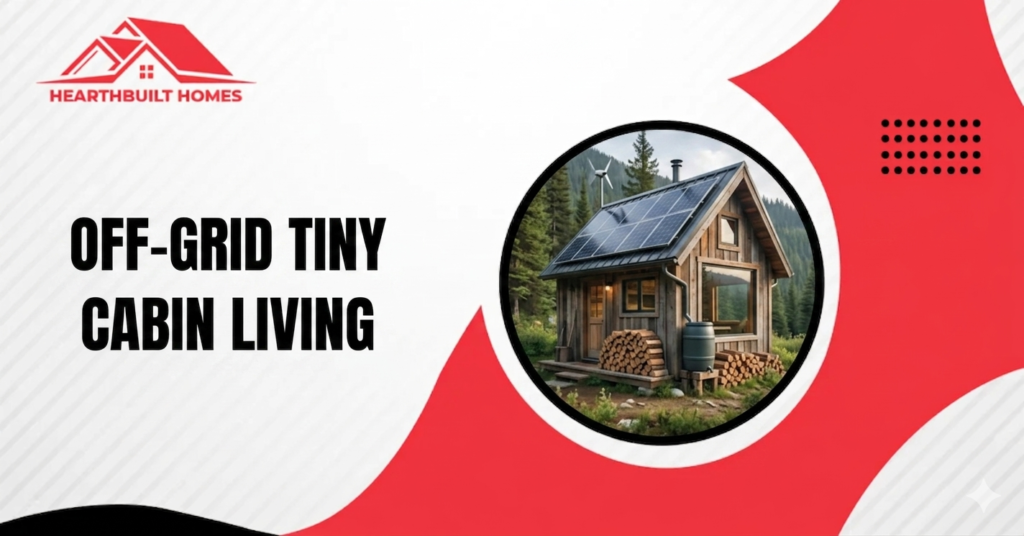
Wake up to wind moving through pine branches instead of a phone alarm. No utility bill arrives at the end of the month, because there’s no utility company involved in the first place. That’s the pitch. The actual experience of off-grid tiny cabin living involves a lot more wood-splitting and battery monitoring than the curated photos suggest — but for thousands of people now working remotely and chasing financial independence, the trade is worth it.
The sustainable lifestyle movement has shifted from niche to mainstream over the past several years. Remote work flexibility untethered people from city offices, and rising housing costs pushed many toward a smaller, self-sufficient footprint instead of a bigger mortgage. This guide walks through the entire transition: the zoning laws that can make or break your plan, sizing a tiny cabin solar power system that actually keeps the lights on through winter, managing water and waste without modern plumbing, and the real dollar figures behind an off-grid tiny cabin setup, from raw land to move-in day.
Why Choose Off-Grid Tiny Cabin Living?
Before the practical mechanics, it helps to understand what’s actually driving people toward off-grid housing solutions in the first place.
Financial freedom tops the list. Eliminating a thirty-year mortgage and monthly utility bills changes the entire shape of a household budget. The Tiny Home Industry Association has tracked average tiny home costs running dramatically lower than traditional homes, and once a cabin is paid off, the only ongoing costs are maintenance and the occasional fuel delivery.
Environmental impact is the second major draw. A structure under 400 square feet uses a fraction of the materials, heating energy, and embodied carbon of a standard single-family home. Pair that with solar power and renewable heating, and the carbon footprint of sustainable off-grid cabin solutions shrinks even further.
Mental well-being rounds out the case. Researchers studying “nature-deficit” effects have linked time outdoors and slower daily rhythms to measurable drops in stress. Off-grid cabin living forces both, since there’s no scrolling through a commute when your morning starts with checking the battery bank instead.
Finding Land and Navigating Tiny Home Zoning Laws
This is the step that quietly kills more off-grid dreams than any technical hurdle ever does. You can’t simply park a cabin on a piece of land and call it home — zoning law decides that for you, long before solar panels or composting toilets enter the picture.
Zoning restrictions come in two common forms. Many counties enforce minimum square footage requirements for permanent dwellings, which can disqualify a tiny cabin outright. Plenty of jurisdictions separately ban full-time living in an RV or mobile structure regardless of its size, even on privately owned land. The legal landscape varies enormously from state to state, and often from county to county within the same state.
Off-grid friendly states have built real reputations over the years. Parts of Colorado, rural Texas counties, and much of Maine are frequently cited for looser tiny home zoning and a cultural tolerance for self-sufficient homesteading. That reputation can still change at the county line, so always verify with the specific local planning office before buying any land.
Before committing to any parcel, work through a land assessment checklist:
- Sun exposure across all four seasons, not just summer — solar panels need consistent winter access too.
- Soil percolation rate, which determines whether a septic or greywater system will function at all.
- Access to a water table or natural spring within a reasonable drilling depth.
- Road accessibility during winter, since a snowed-in driveway turns a peaceful retreat into a logistics problem fast.
Tiny Cabin Solar Power System: Powering Up Without the Grid
Living off-grid doesn’t mean living without electricity. It means becoming your own utility company — which is a genuinely different job.
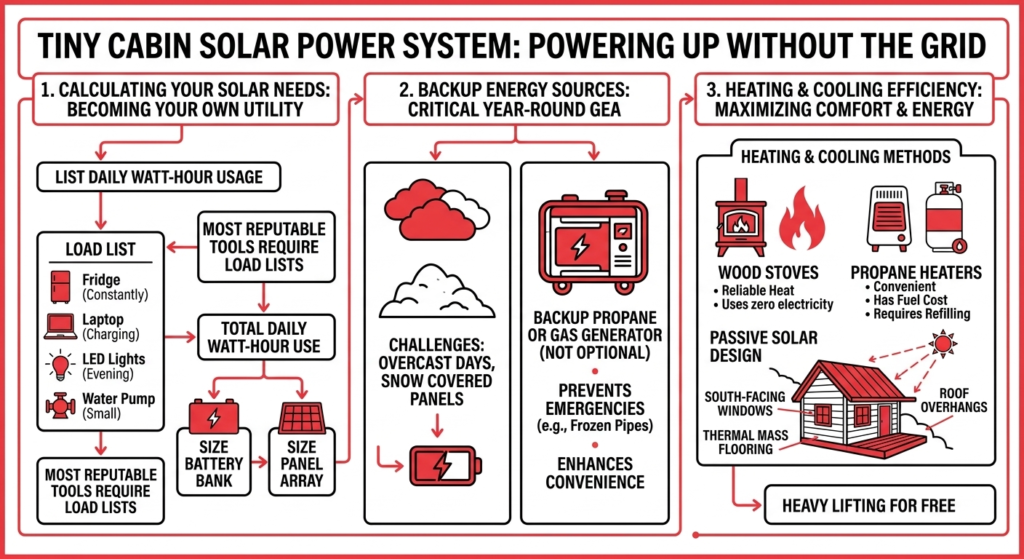
Sizing a solar system starts with adding up daily watt-hour usage: a fridge running constantly, a laptop charging, LED lights in the evening, maybe a small water pump. That total daily watt-hour figure determines how large a battery bank and panel array you actually need, rather than guessing and overbuying equipment you can’t fully use. Most reputable off-grid solar calculator tools ask for exactly this load list before recommending a system size.
Backup energy sources matter more than glossy marketing photos tend to admit. A string of overcast winter days, or heavy snow burying the panel array, can drain a battery bank faster than expected. A backup propane or gas generator isn’t optional gear for serious year-round off-grid cabin living — it’s the difference between minor inconvenience and a frozen-pipe emergency.
Heating and cooling efficiency separates comfortable cabins from miserable ones. Wood stoves provide dense, reliable heat without draining the battery bank at all, while propane heaters trade that efficiency for convenience and a recurring fuel bill. Passive solar design — south-facing windows, thermal mass flooring, generous roof overhangs — quietly does a remarkable amount of heavy lifting for free.
Water and Waste: The Unglamorous Reality of Self-Sufficiency
This is where the romanticized version of off-grid tiny cabin living meets reality head-on. Mismanage water or waste, and the whole arrangement falls apart within a single season.
Off-Grid Water Systems
Rainwater harvesting is popular and effective, but it isn’t legal everywhere — a handful of states restrict or regulate collection outright, so checking local law before installing a cistern saves a costly teardown later. Filtration is non-negotiable regardless of location, since roof runoff carries debris and bacteria that need treatment before it ever reaches a tap.
Well drilling costs considerably more upfront but delivers long-term reliability that rainfall alone can’t match during a dry season. Depth and cost depend entirely on the local water table, which is one more reason the land assessment checklist matters before any contract is signed.
The Waste Dilemma
Composting toilets have become the standard solution for self-sufficient tiny cabins, breaking waste down aerobically instead of requiring a septic line. Brands like Nature’s Head and Laveo are frequently recommended for reliable odor control and minimal upkeep. Done right, there’s no smell at all; done wrong, it’s the first thing every guest notices.
Greywater systems divert sink and shower runoff toward non-edible landscaping, recycling water that would otherwise go straight to waste. It’s a simple loop that meaningfully cuts a cabin’s total water demand over time.
Designing for Efficiency: Maximizing Small Spaces
When the entire footprint rivals a standard bedroom, every square inch needs a job to do.
- Multi-functional furniture — Murphy beds, storage stairs, and drop-leaf tables can turn one room into three depending on the hour.
- Vertical storage — high ceilings make room for sleeping lofts and shelving that floor space alone could never provide.
- Indoor-outdoor flow — large windows and a covered deck visually double a tiny cabin’s livable area without adding a single square foot.
The Real Cost of Off-Grid Tiny Cabin Living
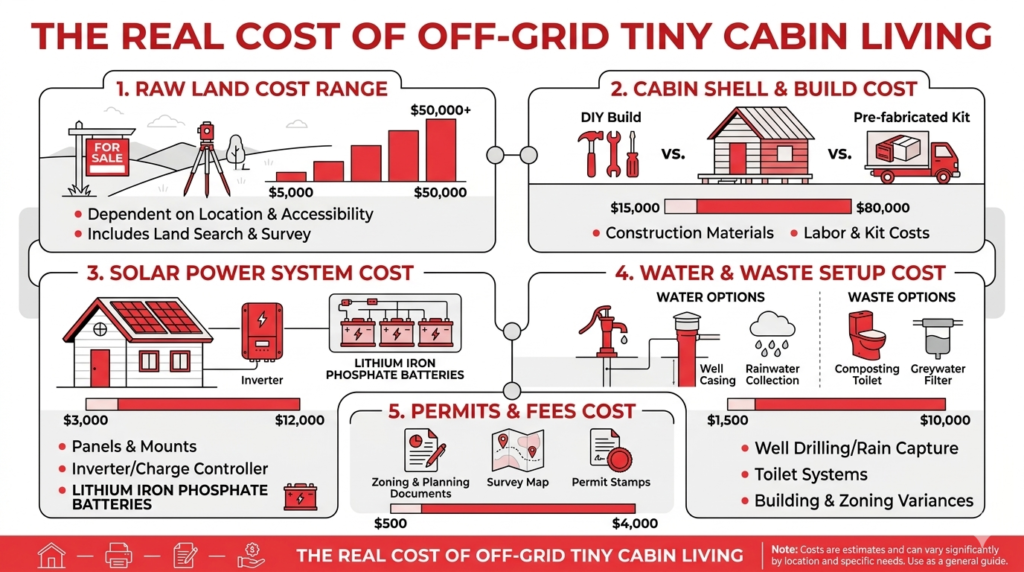
Off-grid living tends to be cheaper over the long run, but the setup costs catch plenty of beginners off guard. Here’s a realistic breakdown of what off-grid tiny cabin cost actually looks like across every major category.
Expense Category | Estimated Cost Range (USD) | Notes |
Raw Land | $5,000 – $50,000+ | Highly dependent on location and accessibility. |
Cabin Shell/Build | $15,000 – $80,000 | DIY build vs. prefabricated kit. |
Solar Power System | $3,000 – $12,000 | Includes panels, inverter, and lithium iron phosphate batteries. |
Water & Waste Setup | $1,500 – $10,000 | Composting toilet to deep-well drilling. |
Permits & Fees | $500 – $4,000 | Surveying, building permits, and zoning variances. |
The Mental Shift: Overcoming the Challenges of Tiny Cabin Living
It’s not all coffee on the porch at sunrise. Off-grid tiny cabin living for beginners comes with real, ongoing friction that social media rarely shows.
The chore load is constant: chopping wood, hauling water, checking battery voltage before bed every single night. These aren’t weekend tasks — they’re daily maintenance that doesn’t pause for bad weather or a bad mood.
Isolation versus solitude is a distinction worth sitting with honestly before moving. Trading urban convenience for quiet, remote land is freeing for some people and genuinely difficult for others, and it’s worth an honest gut-check before signing a land deed.
The reward, for those who stick with it, is a level of self-reliance that’s hard to describe to anyone who hasn’t hauled their own water or watched their own panels charge a battery bank through a passing storm.
Conclusion
Off-grid tiny cabin living rewards careful planning far more than it rewards enthusiasm alone. Get the zoning right, size the solar system honestly, plan for water and waste before move-in day, and the financial and environmental payoff more than justifies the upfront work involved.
Don’t go from zero to land purchase in one leap. Rent an off-grid cabin for a long weekend first, or spend a month tracking your actual household energy use before sizing a system around it.