
You order a fully furnished, smart home integration-enabled living module online, it arrives on a flatbed truck, and a crane drops it onto your property in a single afternoon. That’s not science fiction — that’s the reality of capsule houses vs traditional homes, one of the most heated debates in modern real estate right now.
As housing costs have surged past all-time highs and interest rates have remained stubbornly volatile, traditional homeownership is slipping out of reach for millions of millennials and Gen Z buyers. The national median home price now sits above $420,000, according to the National Association of Realtors (NAR). Against that backdrop, it’s no wonder that space-age living modules built from aluminum, steel, and panoramic smart glass are going viral on TikTok and YouTube every week.
But can a prefab capsule genuinely replace a brick-and-mortar home? Or are they an expensive, overhyped gimmick — glorified RVs with a designer price tag? This guide breaks down the real numbers, the legal landmines, the durability data, and the lifestyle trade-offs so you can make the right call for your future. We’re comparing capsule house cost, construction speed, zoning realities, sustainability, and long-term value — side by side.
What Is a Capsule House? Defining the Space-Age Disruptor
A capsule house — also called a modular pod home or prefab capsule home — is a prefabricated, factory-built living unit constructed primarily from steel frames, aluminum shells, and double-insulated panoramic smart glass. Unlike traditional construction where workers pour foundations, frame walls, and install wiring over months on your lot, capsule homes are built almost entirely in a controlled factory environment.
The ‘plug-and-play’ promise is real. Major manufacturers like Volferda and Vesna deliver units that are 100% complete from the factory — HVAC systems, integrated appliances, lighting automation, and smart home controls are already wired in before the unit ever leaves the facility. Standard models typically range from 200 to 450 square feet, though larger multi-module configurations can exceed 1,000 square feet.
What makes them genuinely different from a manufactured home or an RV is their build quality and technology integration. High-end capsule units feature seismic ratings up to Magnitude 8, military-grade aluminum cladding, and factory-precision insulation tolerances that most on-site builds can’t match. They’re not camping pods — they’re compact living solutions designed for permanent or semi-permanent habitation.
Capsule House Cost vs. Traditional Home: The Full Financial Picture
The Upfront Numbers
Capsule house base prices generally run $30,000 to $100,000+ depending on size, finish level, and smart-tech package. A standard 300 sq ft premium unit from a top-tier manufacturer will typically land between $45,000 and $75,000 before any site work.
Compare that to the U.S. median existing home price of $422,600 (NAR, Q1 2025) and the appeal is obvious. For buyers who already own land, a capsule home can represent an 80–90% reduction in pure structure cost.
The Hidden Costs of Capsule Houses — Read This Carefully
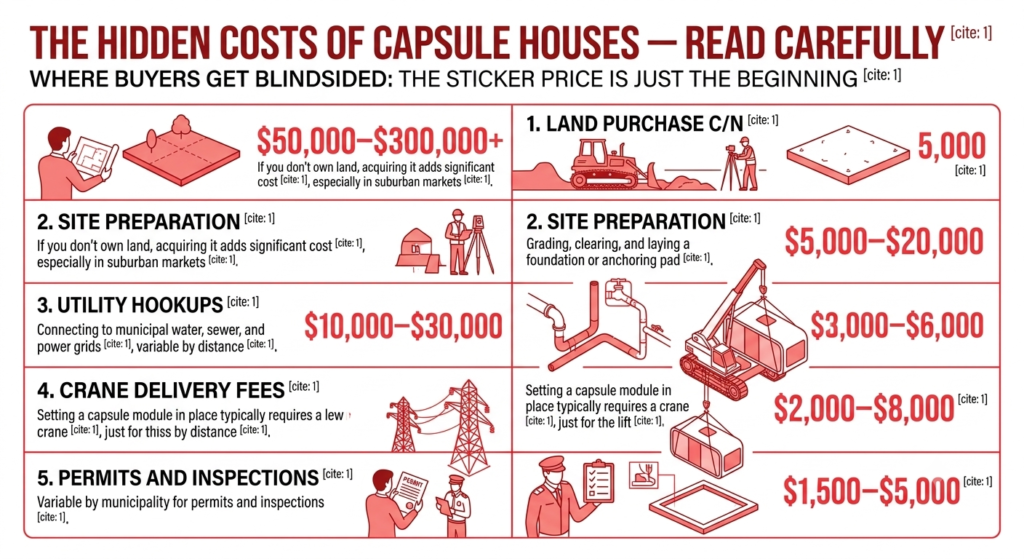
Here’s where many buyers get blindsided. The sticker price of the module is just the beginning. The real hidden costs of capsule houses include:
- Land purchase or lease: If you don’t own land, you still need to acquire it. In suburban markets, this alone can add $50,000–$300,000+.
- Site preparation: Grading, clearing, and laying a foundation or anchoring pad — typically $5,000–$20,000.
- Utility hookups: Connecting to municipal water, sewer, and power grids can cost $10,000–$30,000 depending on distance and local rates.
- Crane delivery fees: Setting a capsule module in place typically requires a specialized crane. Expect $2,000–$8,000 just for the lift.
- Permits and inspections: Variable by municipality, but budget $1,500–$5,000.
Add it up, and a $60,000 capsule module can realistically cost $90,000–$130,000 all-in — still significantly cheaper than a traditional home in most U.S. markets, but the gap narrows considerably.
The Financing Hurdle: A Critical Warning
Traditional banks do not offer standard 30-year mortgages for most capsule homes. Because they’re often classified as personal property rather than real estate — similar to manufactured home financing — buyers typically must rely on personal loans, RV loans, manufacturer financing programs, or pay cash.
This is a deal-breaker for buyers who were counting on leveraging a small down payment. Traditional homes, by contrast, qualify for FHA loans (3.5% down), VA loans (0% down for eligible veterans), and conventional 30-year mortgages that spread the financial load over decades. That financing infrastructure is a massive structural advantage for conventional housing — one that capsule buyers need to plan around carefully.
Prefab vs Traditional Construction: Speed vs. Longevity
Build Timeline
Capsule houses win this category decisively. Factory build time runs roughly 30–45 days, with on-site installation taking just 1–2 days via crane placement and utility connection. You could feasibly go from deposit to move-in in under 60 days.
Traditional new construction averages 7–9 months from breaking ground to occupancy — and that’s if supply chain delays, subcontractor scheduling, or weather don’t push the timeline to 12–18 months, which is increasingly common in the post-pandemic construction environment.
Structural Lifespan
This is where prefab vs traditional construction diverges most sharply. Well-maintained traditional homes — especially those built with brick, stone, or quality wood framing — are generational assets. A 1920s craftsman bungalow, properly maintained, can outlast its third or fourth owner. Traditional homes routinely stand 100+ years.
Capsule homes, by contrast, carry manufacturer-stated structural lifespans of 30–50 years. Their lightweight aluminum and composite materials simply don’t have the long-term track record of masonry or timber-frame construction. This doesn’t make them a bad investment — a 30-year asset can still generate extraordinary ROI — but buyers should factor it into long-term estate planning.
Weather Resistance
Modern capsule units are engineered for serious environmental performance. Leading manufacturers certify their modules to withstand winds up to 90–110 mph and seismic events up to Magnitude 8.0. In many cases, a well-anchored aluminum capsule outperforms a traditional wood-frame house in high-wind or earthquake-prone zones — though it can’t match a properly engineered concrete masonry structure in the most extreme conditions.
Capsule Home Zoning Laws: The Ultimate Make-or-Break Factor
You’ve found the perfect capsule home. You’ve saved the deposit. Then you discover capsule home zoning laws have made your plan legally impossible. This is the most common — and most expensive — mistake capsule buyers make.
The classification problem is real. Depending on jurisdiction, a capsule home may be classified as a modular home, a tiny house on a foundation, a manufactured home, or an RV/mobile structure. Each classification triggers different legal requirements — and some effectively prohibit the structure entirely in residential zones.
Key Zoning Obstacles
- Minimum square footage requirements: Many suburban municipalities mandate minimum dwelling sizes of 800–1,200 sq ft. A 300 sq ft capsule module doesn’t qualify.
- Foundation requirements: Some jurisdictions require permanent foundations, which changes the cost calculus and may reclassify the structure.
- HOA restrictions: Most Homeowners Associations explicitly ban non-traditional structure types.
- ADU regulations: The strongest legal pathway for capsule homes is often as an accessory dwelling unit (ADU) on a property that already has a primary residence — a path that many states, including California, have actively legislated to streamline.
The International Residential Code (IRC) Appendix Q provides a framework specifically designed for tiny houses under 400 sq ft, covering ceiling heights, loft specifications, and egress requirements. States and municipalities that have adopted Appendix Q provide the clearest legal pathway for small modular structures — but adoption is inconsistent across the country. Always verify local code compliance before purchasing a module.
Sustainability and Energy Efficiency: Which Home Is Greener?
The Eco Case for Capsule Houses
Factory assembly-line production generates dramatically less construction waste than on-site building. Precision cutting means virtually no material overruns. Recyclable aluminum cladding can be repurposed at end-of-life. Double-insulated smart glass panels and factory-applied weatherstripping create an air-tight thermal envelope that most site-built homes — with their human-error-prone framing and insulation — can’t match.
The result: capsule homes often achieve superior energy performance per square foot. Smaller footprints also mean smaller heating and cooling loads. For eco-conscious buyers, a high-spec capsule home can deliver genuinely low-carbon living — especially when paired with a solar array and battery storage system.
Where Traditional Homes Have the Edge
Traditional construction — particularly brick, stone, or concrete — offers superior thermal mass. These materials absorb heat during the day and release it slowly at night, naturally regulating interior temperatures in ways that lightweight aluminum simply cannot. A well-built masonry home in a temperate climate can reduce HVAC dependency significantly over its lifetime.
Traditional homes also have larger roof surfaces — a critical advantage for mounting substantial solar panel arrays that can offset or eliminate grid energy consumption entirely. A 450 sq ft capsule roof can only accommodate a fraction of the solar capacity of a 2,000 sq ft conventional home.
Capsule Houses vs Traditional Homes: Quick-Reference Comparison Chart
Use this at-a-glance table to compare both options across the metrics that matter most:
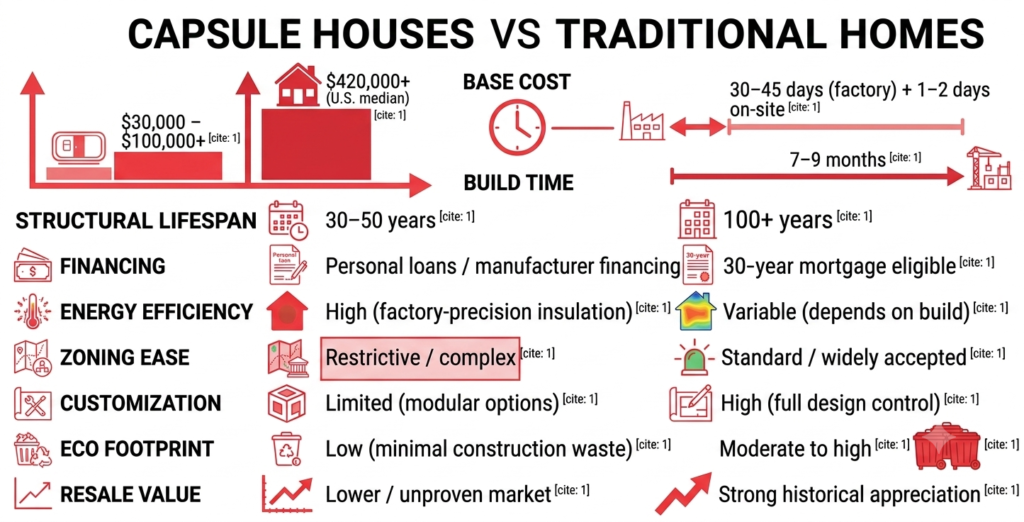
Factor | Capsule House | Traditional Home |
Base Cost | $30,000 – $100,000+ | $420,000+ (U.S. median) |
Build Time | 30–45 days (factory) + 1–2 days on-site | 7–9 months |
Structural Lifespan | 30–50 years | 100+ years |
Financing | Personal loans / manufacturer financing | 30-year mortgage eligible |
Energy Efficiency | High (factory-precision insulation) | Variable (depends on build) |
Zoning Ease | Restrictive / complex | Standard / widely accepted |
Customization | Limited (modular options) | High (full design control) |
Eco Footprint | Low (minimal construction waste) | Moderate to high |
Resale Value | Lower / unproven market | Strong historical appreciation |
Conclusion: Which Path Is Right for You?
Choose a capsule house if: You already own land and want to put it to work fast. You’re building an accessory dwelling unit (ADU) for rental income or a guest suite. You work remotely and need a high-tech, low-maintenance compact studio. You’re committed to minimalist living and want turnkey real estate with built-in smart home tech from day one.
Choose a traditional home if: You’re building a long-term family asset you expect to appreciate and pass down. You need traditional bank financing with a low down payment. You require more than 500 sq ft of finished space. You live in a municipality with restrictive zoning that effectively bans capsule structures. Or you simply want maximum design freedom and the proven structural lifespan of masonry or timber construction.
The smartest buyers aren’t choosing one over the other as a philosophy — they’re evaluating both against their specific land situation, financing ability, local zoning code, and lifestyle requirements. A capsule home is not a compromise. But it’s also not a universal upgrade. It’s a precision tool that performs brilliantly in the right circumstances and poorly in the wrong ones.