
The idea is intoxicating: sell the oversized mortgage, downsize into something compact and intentional, and finally reclaim your financial freedom. Whether you’ve been scrolling through tiny home on wheels builds on YouTube or browsing park model tiny homes for sale at RV expos, the appeal is the same — less space, less debt, more life.
But here’s what most lifestyle bloggers gloss over: tiny houses and park models are not the same thing. They look similar in photographs, they both solve the “too much house” problem, and they can both sit on the same piece of land — but legally, financially, and practically, they operate in completely different worlds.
Confusing the two is one of the most expensive mistakes a downsizer can make. The wrong choice can leave you unable to get a mortgage, stranded in a zoning gray area, or stuck with a structure your insurance company won’t touch. This guide cuts through the noise. We’ll compare the tiny house vs park model across four critical dimensions: legal classification, real-world mobility, total cost of ownership, and daily livability — so you can make the decision that actually fits your life.
What Exactly Is a Tiny House on Wheels?
A tiny house on wheels — commonly abbreviated as THOW — is a custom-built residential dwelling mounted on a heavy-duty trailer chassis. Unlike a manufactured home or a traditional RV, a THOW is engineered and constructed using the same techniques you’d find in a site-built house: 2×4 or 2×6 stud framing, standard residential insulation (spray foam, batts, or rigid board), real wood siding, and conventional roofing materials.
The defining constraint on a THOW is its width. To remain highway-legal without a special permit, the structure must stay at or under 8.5 feet wide. Length typically ranges from 16 to 36 feet, and total living square footage generally falls between 100 and 400 square feet. This narrow profile shapes every design decision — from loft sleeping areas to space-saving furniture and under-stair storage.
The building code landscape for tiny houses has matured significantly. IRC Appendix AQ (published by the International Code Council) provides a formal framework for building and inspecting tiny houses, covering everything from minimum ceiling heights (6 feet, 4 inches) to loft egress requirements. However, Appendix AQ adoption varies by jurisdiction — some cities have embraced it while others still treat THOWs as an unregulated wild west. Third-party certifiers like NOAH (National Organization of Alternative Housing) fill this gap by offering voluntary certification programs that satisfy many local code officials and insurance companies.
The THOW spirit is fundamentally about customization and intentional living. Builders obsess over every cubic inch. Off-grid capability is a common priority — solar panels, composting toilets, rainwater collection systems, and propane cooking are standard features in many builds. For people who want a home that reflects their exact values and aesthetic, a tiny house is the most expressive option on the market.
What Exactly Is a Park Model RV (PMRV)?
A park model RV — officially a Park Model Recreational Vehicle, or PMRV — occupies a fascinating middle ground between a traditional RV and a manufactured home. It is factory-built, transported to its destination in one piece, and designed for permanent or semi-permanent placement at a campground, RV resort, or private lot with utility connections. Despite looking like a cozy cottage or a mini-chalet, it is legally classified as a recreational vehicle.
That 400 square foot ceiling is not arbitrary — it’s the threshold that keeps the park model inside the RV tax and regulatory classification rather than tipping it into manufactured housing territory (which falls under HUD code instead). In practice, park models are built to be wider than tiny houses: most are 11 to 12 feet wide, with some models pushing 14 feet when slide-outs are fully extended. That extra width is what gives them their cottage-like feel with full-sized furniture, standard appliances, and main-floor bedrooms.
Every park model manufactured in the United States must comply with ANSI A119.5, the national safety and engineering standard that governs structural integrity, electrical systems, plumbing, and fire safety for recreational park trailers. Compliance earns the unit an ANSI certification label affixed directly to the structure — a credential that is instantly recognizable to insurance underwriters, campground operators, and lenders.
Park models are produced by major manufacturers including Cavco, Skyline, Kropf, and Athens Park Homes. They arrive at their destination as a finished product — paint, cabinets, appliances, flooring, and all — and are typically skirted and connected to 50-amp electrical service, city water, and sewer within days of delivery.
The Legal Matchup: Zoning, Building Codes, and Certification
If there is one section of this guide that could save you from a catastrophically expensive mistake, this is it. The legal framework governing where you can park and live in each of these structures is dramatically different — and it changes by county, city, and even neighborhood.
Certification: Factory Sticker vs. Third-Party Inspection
Park models arrive with their ANSI A119.5 certification label already attached from the factory. This single sticker does an enormous amount of legal and financial heavy lifting: it tells your insurer what they’re covering, it tells your campground operator that your unit is compliant, and it tells your lender they can issue an RV loan against it. There is no inspection process you need to initiate — certification is baked in at the manufacturing stage.
Tiny houses face a patchwork of options. Some builders voluntarily pursue NOAH certification or certification through the Recreational Vehicle Industry Association (RVIA), which gives their THOW the same RV designation as a park model. Others build to IRC Appendix AQ standards and seek a local building permit. And some owner-builders construct entirely uncertified DIY homes — which can create significant problems when it’s time to insure, finance, or sell the structure.
Zoning: Where Can You Legally Live?
Park models are legally RVs. This means they are warmly welcomed at virtually every RV resort, campground, and tiny home community in the country. The catch? Most municipalities explicitly prohibit using an RV — including a park model — as a full-time primary residence on private land outside of an approved RV park. If you own rural acreage and want to place a park model on it permanently, you may find yourself in a legal gray area depending on your county’s ordinances.
Tiny houses on wheels occupy an even murkier position. Some forward-thinking municipalities — particularly in states like Oregon, Texas, and Colorado — have amended their zoning codes to allow THOWs as Accessory Dwelling Units (ADUs) on single-family residential lots. Under this framework, you could legally place a tiny house behind an existing home and use it as either a rental or your own primary residence. But in many jurisdictions, zoning codes simply haven’t caught up with the tiny house movement, and living full-time in a wheeled structure on private property remains technically prohibited.
Taxes: Vehicle Registration vs. Real Property
Park models are registered through the DMV and taxed as personal property or vehicles — similar to a car or traditional RV. This typically means lower annual tax obligations than real estate, but it also means the structure doesn’t build equity in the same way a deeded property would. Tiny houses face similar DMV registration requirements when on wheels, but if a THOW is reclassified as a permanent ADU on land, it may be subject to standard real estate property taxes.
Mobility and Transportation: How ‘Mobile’ Are They, Really?
Both structures market themselves on the promise of mobility — the freedom to pick up and go. The reality is more nuanced. Transporting a park model is not a weekend project, and even moving a tiny house requires planning that most people underestimate. Here’s the honest breakdown:
Feature | Tiny House (THOW) | Park Model RV (PMRV) | Why It Matters |
Average Width | 8.5 feet | 11–12 feet | Determines highway legality |
Towing Vehicle | F-250/F-350 pickup truck | Professional semi-truck | DIY vs. hired transport |
Permit Requirements | Standard highway load | Oversize load permit required | Cost & lead-time to move |
Ideal Relocation Frequency | A few times per year | Rarely — once every few years | Reflects true lifestyle fit |
A tiny house on wheels, while technically highway-legal at 8.5 feet wide, still requires a heavy-duty towing vehicle — typically an F-250 or F-350 Super Duty with a weight rating that matches the THOW’s gross vehicle weight (often 14,000–20,000 lbs for a fully finished tiny house). Most tiny house owners can move their home a few times a year without extraordinary cost, but it’s not something you do on a whim.
Park models are genuinely designed to be parked and left. At 11–12 feet wide, they exceed standard highway width limits and therefore require a professional oversize load permit, pilot cars (in most states), and a licensed transport company with the equipment to handle the load safely. The cost to move a park model typically ranges from $1,500 to $5,000+ depending on distance, and in some states you can only legally transport them during specific hours and days. This is a structure you move once — to its permanent home — and leave there for years.
Financial Breakdown: Upfront Costs, Financing, and Insurance
Purchase Price Comparison
Let’s start with the numbers that matter most:
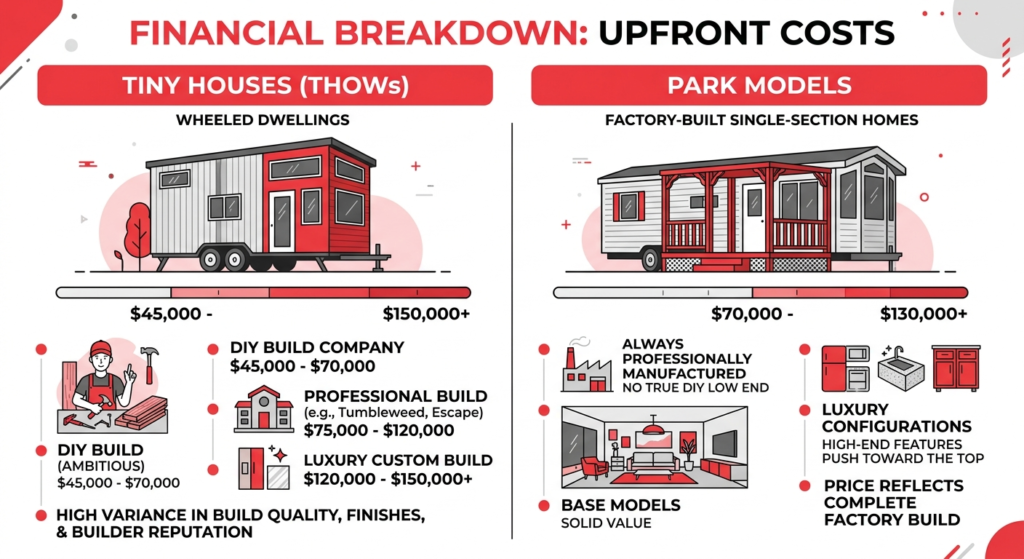
- Tiny Houses: $45,000 (ambitious DIY build) to $150,000+ (luxury custom builder). The wide range reflects the enormous variance in build quality, finish level, and builder reputation. A professionally built THOW from an established company like Tumbleweed or Escape Homes typically lands between $75,000 and $120,000.
- Park Models: $70,000 to $130,000+ (factory-built, all configurations). Because park models are always professionally manufactured, there’s no true DIY low end. Base models offer solid value; luxury configurations with slide-outs, granite countertops, and custom cabinetry push toward the top of the range.
Financing: The ANSI Advantage
This is where the park model’s ANSI certification pays its biggest dividend. Because a PMRV is a certified RV, it qualifies for standard RV loans through lenders like Good Sam Finance Center, Lyon Financial, and many credit unions. These loans typically feature 10–15 year terms with competitive interest rates, and the approval process is well-understood by lenders.
Tiny homes are significantly harder to finance. The lack of universal certification means most traditional lenders can’t easily categorize a THOW — they’re not a car, not a mobile home, and not a traditional house. Buyers typically rely on personal loans (higher interest, shorter terms), builder-specific financing programs, or cash purchases. Some THOW builders have partnered with specialty lenders, but this remains one of the most common pain points in the tiny house world.
Insurance: Certified vs. Custom
RV insurance for a certified park model is straightforward and competitively priced. Major RV insurers — Progressive, Good Sam, National General — have standardized policies for PMRVs because the ANSI certification gives them reliable actuarial data. Coverage for full-replacement value, personal liability, and even vacation liability (if the unit is rented out) is readily available.
Insuring an uncertified or DIY tiny house can be genuinely difficult. Some standard homeowner’s insurers won’t touch a wheeled structure; standard RV insurers may require proof of certification; and specialty insurers (like National Mobile Home, Foremost, or American Family) may offer coverage but at higher premiums with more stringent underwriting. If your THOW has a certification (NOAH, RVIA), this problem largely disappears — which is one of the strongest arguments for pursuing voluntary certification on any tiny house.
Livability, Design, and Layout: Which Feels More Like Home?
Space, Width, and the Daily Experience
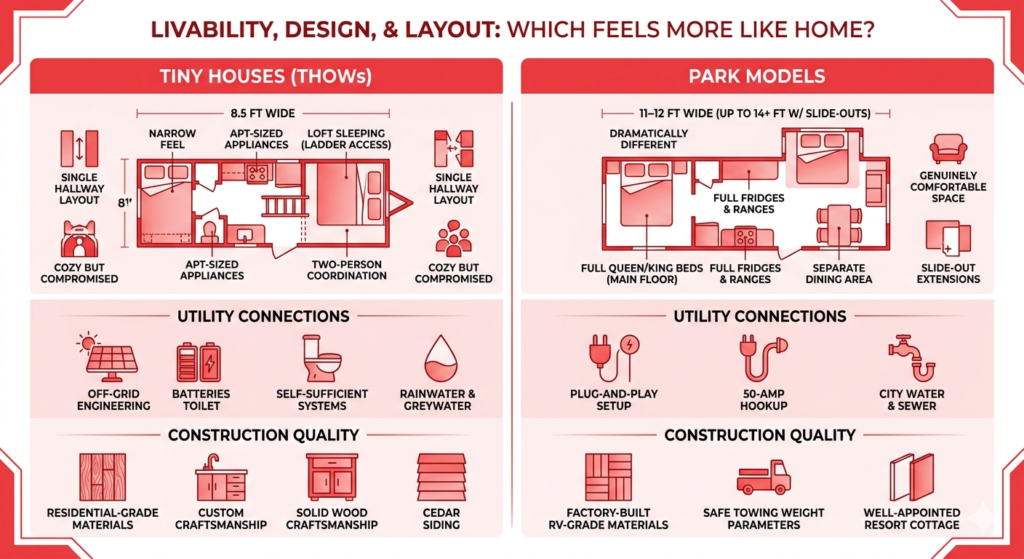
Width is destiny in small-space living. At 8.5 feet wide, a tiny house feel inherently narrow — a single hallway with rooms branching off it. This is livable and even cozy with thoughtful design, but it means compromise: appliances are often apartment-sized, sleeping is frequently in a loft accessed by a ladder or steep stairs, and two people moving through the kitchen at once requires coordination.
At 11–12 feet wide, a park model feels dramatically different. Park model floor plans can accommodate full queen or king beds on the main floor, side-by-side refrigerators, full 30-inch ranges, and even separate dining areas. The extra three to four feet of interior width is the difference between ‘cleverly compressed’ and ‘genuinely comfortable.’ Many park models feature slide-outs that extend the living space further when parked, pushing effective interior width past 14 feet.
Utility Connections: Plug-and-Play vs. Off-Grid
Park models are engineered for 50-amp hookup to standard campground or RV park electrical pedestals. Their plumbing connects directly to city water and sewer systems, and their HVAC is typically a mini-split or heat pump rated for the structure’s footprint. There is no complexity here — you arrive, connect three utilities, and you’re home.
Tiny homes can do the 50-amp hookup too — but they also excel at off-grid engineering in a way that park models simply can’t match. A well-designed THOW can incorporate a robust solar array, lithium battery bank, a composting toilet, greywater recycling, and a rainwater collection system that makes the home genuinely self-sufficient. For buyers prioritizing energy independence, remote placement, or sustainability credentials, this is an area where tiny houses have no equal.
Construction Quality and Finishes
Custom tiny house builders frequently use residential-grade materials that rival or exceed what you’d find in a traditionally built home: real hardwood or engineered wood flooring, quartz or butcher block countertops, solid wood cabinetry, and fiber cement or cedar siding. The craftsmanship in a professionally built THOW can be genuinely exceptional.
Park models, by contrast, are bound by the weight constraints of their RV classification. Factory-built RV-grade materials — lighter-weight vinyl flooring, laminate surfaces, thinner wall panels — keep the unit within safe towing weight parameters. They are perfectly functional and often attractively finished, but they typically don’t match the material quality achievable in a custom tiny house. Think ‘well-appointed resort cottage’ rather than ‘custom craftsman home.’
The Verdict: Which One Is Right for You?
There is no universal winner in the tiny house vs park model debate — there’s only the right fit for your specific situation. Here’s the decision framework that actually works:
Choose a Tiny House on Wheels If:
- You want a deeply customized home that reflects your specific aesthetic, values, and design vision.
- Off-grid living, energy independence, or remote placement is a priority.
- You live in a jurisdiction with ADU-friendly zoning laws that would allow you to place the THOW on private land.
- You want the option to move your home yourself a few times per year without hiring a professional transport company.
- You’re comfortable navigating the more complex financing, certification, and insurance landscape — or you plan to pursue NOAH or RVIA certification.
Choose a Park Model RV If:
- You want a wider, more traditional living layout with standard-sized appliances, a main-floor bedroom, and room for two people to comfortably coexist.
- You plan to place the home in an RV resort, campground, or dedicated tiny home community where ANSI certification is a requirement.
- Easy, conventional financing through an RV loan is important to your purchasing plan.
- You want a move-in-ready, factory-built home with predictable quality and straightforward insurance.
- You anticipate leaving the home in one location for many years with minimal relocation needs.
The most important step either way is to verify your local zoning codes before you sign anything. Call your county planning department, ask specifically about tiny houses on wheels and park model RVs, and get the answer in writing. Do that first, and the rest of the decision becomes significantly easier.