
- By HearthBuilt Homes
- June 8, 2026
- no comment
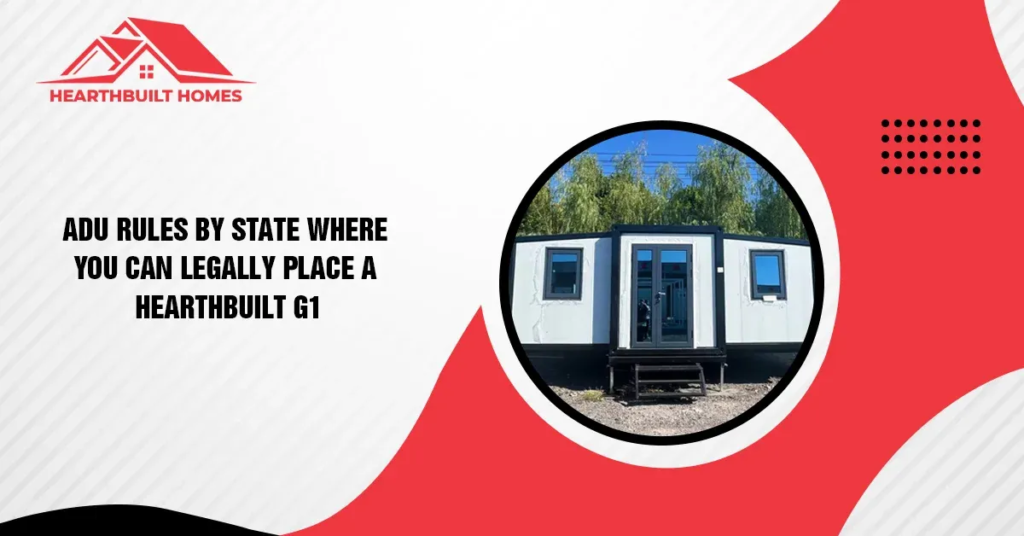
ADU Rules by State: Where You Can Legally Place a HearthBuilt G1
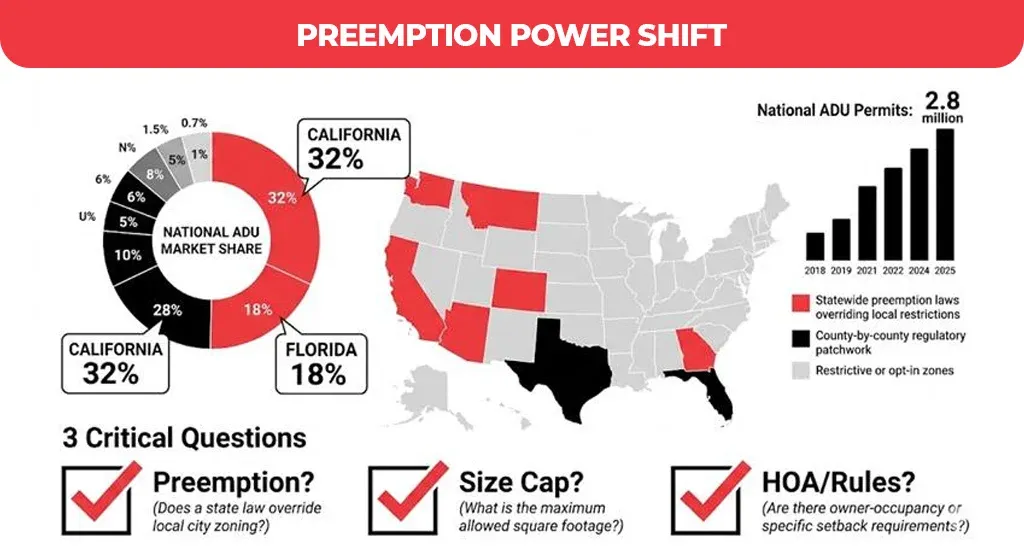
Ten years ago, ADUs were governed almost entirely at the city level. That’s no longer true. Since 2020, 14 states have passed pre-emptive legislation overriding restrictive city and county zoning. This means your municipality cannot block a legal ADU simply because the local council prefers single-family-only neighborhoods.
According to the Shovels ADU permit dataset, 2.8 million ADU permits were issued in the U.S. between 2018 and 2025. The market share breaks down as follows:
- California: 32%
- Florida: 18%
- Texas: 8%
- North Carolina: 6%
- Arizona: 3%
Before you order a G1 tiny cabin or any other factory-built ADU, you need to know three critical things about your state:
- Is there a state preemption law?
- What is the square-footage cap?
- What are the owner-occupancy, setback, and parking rules?
ADU Terminology Cheat Sheet
- ADU (Accessory Dwelling Unit): A secondary dwelling located on a single-family lot.
- Detached ADU (DADU): Stands free from the primary residence. A HearthBuilt G1 is almost always classified as a DADU.
- Attached ADU: Shares a wall or structural connection with the primary residence.
- JADU (Junior ADU): Typically $\le$ 500 sq ft, carved out of an existing primary structure.
- Owner-occupancy requirement: A rule requiring the property owner to live in either the primary home or the ADU.
- By-right: An ADU application that must be permitted without discretionary municipal review.
- Impact fees: Municipal charges on water, sewer, parks, or schools triggered by new construction.
High-Volume ADU States
California — The Gold Standard
California ADUs account for 32% of national permits. Key 2026 rules include:
- By-Right Permitting: Detached ADUs are permitted by right on all single-family lots, statewide.
- Maximum Size: Up to 1,200 sq ft for detached units.
- Setbacks: 4 ft side and rear; no front setback required.
- Owner-Occupancy: Prohibited (cannot be required by local municipalities).
- Impact Fees: Prohibited for ADUs under 750 sq ft.
- Parking: One off-street parking space per unit, waivable if within ½ mile of public transit.
Florida — Permissive But County-Variable
Accounting for 18% of national ADU permits, Florida does not have a statewide preemption law. Rules vary heavily by county:
- Most counties permit ADUs up to 800–1,000 sq ft with standard setbacks.
- Friendliest Counties: Miami-Dade and Broward.
- More Restrictive: Palm Beach County.
Texas — County-by-County Patchwork
Holding 8% of national permits, Texas has no statewide ADU law.
- Rural Regions: Counties like Hood, Bastrop, and Henderson are particularly friendly to tiny homes.
- Urban Cores: Austin, Houston, and Dallas have passed permissive local ADU ordinances, but their suburbs often retain restrictive single-family zoning.
North Carolina — Growing Fast
Capturing 6% of national permits, the growth is heavily led by urban and progressive areas:
- Leaders: Durham and Asheville lead the charge, followed closely by rural Piedmont counties.
- Standard Caps: Typical size caps range from 800–1,000 sq ft with setbacks of 5–10 ft.
Arizona — 2023 Legislative Push
Currently at 3% of permits and rising fast due to the 2023 ADU preemption law (HB 2721, enforced 2024).
- Detached ADUs up to 1,000 sq ft are permitted by right in all cities with populations over 75,000.
Pro-ADU Reform States
Colorado — HB24-1152
Took effect June 30, 2025.
- Requires all metro-area municipalities to allow detached ADUs up to 750 sq ft by right.
- Setbacks are capped at 5 ft, and parking requirements are completely eliminated for units under 750 sq ft.
Oregon — HB 2001
Oregon’s original HB 2001 (2019) legalized two units per lot statewide. 2024 amendments extended by-right ADU permitting to all cities with a population over 10,000. Portland maintains the highest ADU density outside of California.
Washington — 2023 Preemption
An omnibus housing bill preempted local ADU restrictions in cities over 25,000 population.
- Allows up to two ADUs per lot (one attached, one detached).
- No owner-occupancy requirements.
Montana — SB 528 (2024)
- Allows one ADU per lot in cities over 5,000 population.
- Imposes a 1,000 sq ft maximum size cap and 5 ft setbacks.
Georgia — HB 1166 (Effective 2026)
Taking effect in 2026, this law legalizes ADUs up to 400 sq ft statewide by right. This threshold is specifically sized to permit tiny cabins like the HearthBuilt G1 without needing a conditional use permit.
Rural-Friendly, No-Statewide-Law States
In many rural counties across states like Kentucky, Tennessee, West Virginia, Alabama, Mississippi, Arkansas, Oklahoma, Kansas, Nebraska, South Dakota, Wyoming, Idaho, and New Mexico, there is no overarching state ADU statute.
However, county zoning is typically permissive by default:
- Site-built and modular ADUs on parcels of 5+ acres rarely face local opposition.
- The Catch: Utility hookups and septic permits can take 60–120 days to secure in these jurisdictions.
Restrictive and Opt-In States
A handful of states still make ADU development difficult for homeowners:
- New Jersey: No preemption; most municipalities require a formal zoning variance for any detached ADU.
- Connecticut: Passed a preemption law in 2021 but allowed municipalities to opt out; roughly 40% have done so.
- Massachusetts: The 2024 Affordable Homes Act requires ADU approval in single-family zones, but local implementation remains uneven.
- New York State: State-level preemption has repeatedly stalled. NYC is permissive of basement conversions but hostile to detached units (DADUs).
- Hawaii: Controlled county-by-county. Honolulu is highly permissive, while the neighbor islands are not.
Typical Setbacks and Size Caps
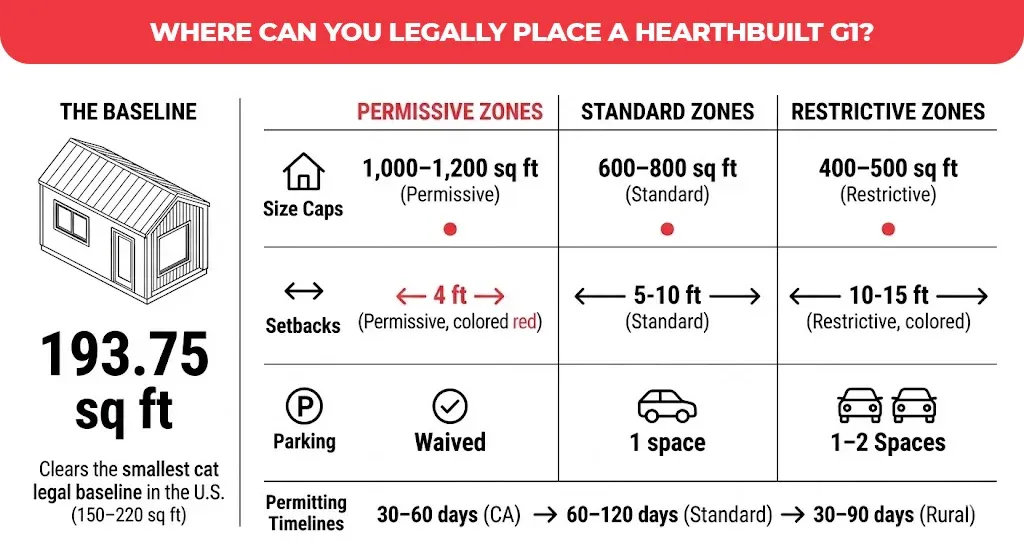
Across the 50 states, the most common 2026 baseline metrics for detached ADUs break down into three categories:
Parameter | Permissive States | Standard States | Restrictive States |
Maximum Size (DADU) | 1,000–1,200 sq ft | 600–800 sq ft | 400–500 sq ft (or requires variance) |
Side Setback | 4 ft | 5–7 ft | 10–15 ft |
Rear Setback | 4 ft | 5–10 ft | 10–20 ft |
Max Height | 20–25 ft | 16–18 ft | 16 ft |
Parking | Waived | 1 space | 1–2 spaces + garage |
Owner-Occupancy | Not required | Sometimes required | Always required |
Grants and Financing by State
Many state governments offer financial incentives to encourage ADU construction. Notable 2026 programs include:
- California ADU Grant Program: Up to $40,000 per qualifying household for pre-development costs.
- New York Plus One ADU Program: Up to $395,000 for low-income homeowners (the most generous initiative in the country).
- Vermont Home Improvement Assistance Program: Up to $50,000 toward ADU construction costs.
- Massachusetts Momentum Fund: Forgivable loans up to $50,000.
- Oregon ADU Tenant Protection Program: Up to $20,000 paired with a mandatory affordability covenant.
Alternative Financing: Beyond grants, homeowners utilize Fannie Mae HomeStyle Renovation loans, VA Energy Efficient Mortgages, HELOCs, and emerging ADU-specific second mortgages from alternative firms like Aven and Noah.
Where a HearthBuilt G1 Slots in Legally
At 193.75 sq ft, the G1 tiny cabin falls well under the maximum size cap in every U.S. state—including Georgia’s strict 400 sq ft threshold. For most buyers, the real legal questions focus on utility and placement:
- Is it a dwelling unit or an accessory structure? If your G1 includes a kitchen, bathroom, and sleeping area, it requires a standard ADU permit. If it is configured strictly as a studio, workshop, or guest room (without cooking facilities), many jurisdictions treat it as a simpler accessory structure.
- Does the state require a permanent foundation? Yes in California (piers acceptable), Oregon, Washington, and Colorado. No in Texas, Arizona, and Florida (slabs are optional in select counties).
- Does it need a certificate of occupancy? Required in permissive and standard states when utilized as a primary dwelling unit. It is generally not required in rural, “accessory use” placements.
The G1 ships as a pre-engineered, factory-built modular structure carrying Greenguard Gold, FloorScore, UL2818, and PHI certifications, significantly minimizing friction during local municipal plan reviews.
Ready to Lock in Your Flooring Costs?
HearthBuilt Homes ships factory-direct SPC flooring with 20-mil wear layers and Unilin click-lock systems. Skip the retail markup and protect your margins on your next five deals.
FAQs
Most state and model building codes set a baseline floor of 150–220 sq ft for a legally habitable dwelling unit (usually under IRC Appendix Q or state-specific amendments). The G1 at 193.75 sq ft clears that threshold in nearly all jurisdictions.
This depends entirely on your local municipality. For example, California allows ADUs to be short-term rented for stays of 30+ days, while some specific cities permit shorter lengths. Check our tiny homes pillar page for Airbnb-optimized floor plans.
Typically, yes. Factory-built modular structures must ship with pre-approved engineering documentation regulated under your state’s modular construction program. The HearthBuilt G1 includes a fully stamped engineering set.
- California: 30–60 days by statutory law.
- Standard States: 60–120 days.
- Rural Counties: 30–90 days for accessory-use structures.
We’ll run a free zoning pre-check for your parcel before you commit to a HearthBuilt G1 or G2 build. Email us your address and proposed site plan; we’ll flag any setback, height, or owner-occupancy issues in writing.